Last Updated: November 3, 2026
Quick Summary
Traffic management for infrastructure repairs is the planned control of vehicles, cyclists, and pedestrians around an active work zone so crews can rebuild a road, bridge, or utility line without creating a second hazard. A written plan defines the temporary traffic pattern, devices, phasing schedule, and responsible parties for each phase.
- The typical driver lost 43 hours to congestion and $771 worth of time in 2024.
- Walk the corridor at peak hour and record lane widths, shoulder availability, and sight distance.
- A 2025 review reports traffic restrictions increase risks by 4.2% to 9.13%.
- The MUTCD, published by the Federal Highway Administration, is the controlling standard for temporary traffic control.
- ALL Ways Safe is available 24 hours a day, 7 days a week, 365 days a year.
Table of Contents
- Why Traffic Management for Infrastructure Repairs Decides Project Success
- How to Build a Traffic Management Plan for Construction Repairs
- Step 1: Survey the Site and Classify the Roadway
- Step 2: Choose the Temporary Traffic Pattern
- Step 3: Plan for People, Not Just Vehicles
- Step 4: Sequence Work Around Traffic Volumes
- Step 5: Document Approvals and Responsibilities
- Step 6: Set the Contingency Branch Before You Need It
- Step 7: Verify Before Reopening
- Temporary Traffic Control Devices That Do the Real Work
- Work Zone Safety Best Practices for Crews and Road Users
- Traffic Control Plan Examples for Common Repair Scenarios
- Permits, Standards, and Who Owns Traffic Control on a Repair Job
- Measuring Performance and Planning for Contingencies
- Staffing Your Repair Project with Certified Flaggers
- Frequently Asked Questions
Why Traffic Management for Infrastructure Repairs Decides Project Success
Traffic management for infrastructure repairs is the planned control of vehicles, cyclists, and pedestrians around an active work zone so crews can rebuild a road, bridge, or utility line without creating a second hazard.
The stakes are measurable. According to the American Society of Civil Engineers’ U.S. roads infrastructure analysis, the typical driver lost 43 hours to congestion and $771 worth of time in 2024, up from 42 hours and $733 the year before.
At ALL Ways Safe, we plan traffic control for utility, road, and bridge crews, and projects that treat traffic control as an afterthought often lose time to rework.
Browse our blog for more field guidance on work-zone planning.
How to Build a Traffic Management Plan for Construction Repairs
A traffic management plan for construction is a written document that defines the temporary traffic pattern, the devices that create it, the phasing schedule, and the responsible parties for each phase.
The Iowa State University Center for Transportation Research and Education’s active traffic management case study developed a systematic approach for combining data from multiple sources into active traffic management decisions.
Step 1: Survey the Site and Classify the Roadway
Walk the corridor at peak hour, not at 7 a.m. on a Sunday. Record lane widths, shoulder availability, sight distance, pedestrian generators, and every driveway that will lose access. Classify the roadway by functional type and posted speed, because those drive device spacing and taper length. Note peak-hour volume in each direction and the percentage of trucks, since heavy-vehicle percentages change turning radii and taper needs.
Step 2: Choose the Temporary Traffic Pattern
Decide among a lane closure, lane shift, full road closure with detour, or phased half-width construction. The choice hinges on traffic volume, available alternate routes, and repair duration. Short utility patches usually justify a lane closure; a bridge deck replacement often needs a detour with signed alternate routes. A simple decision rule: if the closure would push peak-hour volume past the capacity of the remaining lanes, shift to night work or a detour rather than accepting a queue that backs into the previous intersection.
Step 3: Plan for People, Not Just Vehicles
A plan that moves cars but strands pedestrians, cyclists, transit riders, or emergency vehicles is incomplete. Map the pedestrian path first, physically separated from traffic, at least as wide as the original sidewalk where feasible, and usable by people with mobility devices. Identify transit stops inside the work zone and decide whether to relocate them or provide a temporary boarding point.
Step 4: Sequence Work Around Traffic Volumes
Schedule the most disruptive operations outside peak windows. Night work costs more in labor and lighting but can cut queue length dramatically on arterial roads. Build the phasing so no phase leaves a lane narrower than your widest vehicle requires, and no phase leaves a gap between barriers where a vehicle could intrude.
Step 5: Document Approvals and Responsibilities
Identify the right-of-way owner and permit office for every jurisdiction the repair touches, submit the plan with device spacing and phasing shown, and confirm flagger certification requirements in writing. Keep the approved plan on site and log any field deviation. Treating approval as a gate before mobilization, not a formality, helps avoid stop-work orders.
Step 6: Set the Contingency Branch Before You Need It
Write a fallback pattern for weather, incidents, and schedule overruns into the plan itself. If a storm forces the crew off the road, the plan should already state whether devices stay in place, who verifies them, and what pattern applies when work resumes. If a vehicle strikes the zone, the plan should name who resets devices and who authorizes reopening.
Step 7: Verify Before Reopening
Before the pattern comes down, walk the corridor and confirm pavement, signage, and striping are restored to a condition road users can read at speed.
Watch out: skipping the pedestrian and emergency-access review in Step 3 is the most common reason a technically sound vehicle plan gets rejected at the permit counter or fails on the first day of work.
Temporary Traffic Control Devices That Do the Real Work
Temporary traffic control devices are the physical equipment that channels road users through or around a work zone. The right mix depends on speed, duration, and visibility, not on what happens to be on the truck.
- Cones and channelizing devices define tapers and lateral shifts; spacing tightens as speed rises.
- Barriers and drums separate workers from live traffic where intrusion risk is high.
- Traffic signs give advance warning, speed advisories, and detour direction.
- Arrow boards and portable signals manage alternating one-lane operations.
- High-visibility apparel keeps flaggers and crews visible in low light.
The U.S. Department of Transportation’s ITS Knowledge Resources briefing on next-generation transportation management centers describes a shift toward predictive analytics and emerging data sources for actively managing traffic.
Work Zone Safety Best Practices for Crews and Road Users
Work-zone safety starts with separation and ends with verification. Positive protection, clear advance warning, and trained flaggers prevent the majority of intrusions, but only if someone checks the setup daily.
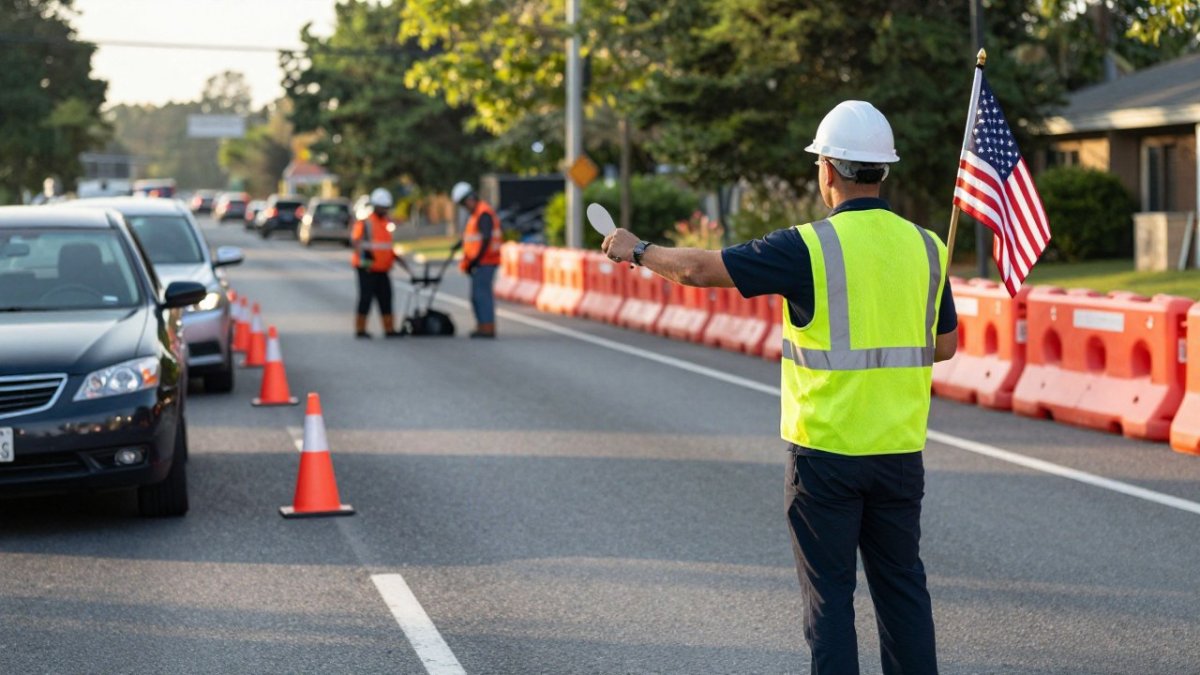
A 2025 review summarized through PubMed Central’s accident-aware traffic management research reports that traffic restrictions increase risks by 4.2% to 9.13%.
Best practices that hold up in practice:
- Place advance warning signs well before the taper, matched to posted speed.
- Give flaggers an escape route and never position them in a live lane.
- Brief the crew on the pattern at the start of every shift, not just the first one.
- Protect vulnerable road users with a pedestrian path that is physically separated, not just coned off.
- Inspect the zone after any vehicle strike and reset devices before resuming work.
Visit our traffic-safety archive for more guidance on protecting crews and the public.
Traffic Control Plan Examples for Common Repair Scenarios
Traffic control plan examples show how the same principles scale differently across repair types. Three scenarios cover most of what field teams encounter.
Utility patch on a two-lane collector: one lane closed with alternating flow controlled by flaggers, advance warning signs on both approaches, and a 15-meter taper.
Emergency main break on a residential street: full closure with a short local detour, driveway access maintained where possible, and notification to adjacent properties before mobilization.
| Repair Type | Typical Pattern | Key Devices | Watch Out For |
|---|---|---|---|
| Utility patch | Alternating one-lane | Cones, signs, flaggers | Taper too short for speed |
| Bridge deck | Lane shift, barrier-protected | Barriers, arrow board | Barrier gaps at phase changes |
| Emergency main break | Full closure, local detour | Signs, barricades, high-visibility apparel | Unnotified residents, blocked driveways |
Permits, Standards, and Who Owns Traffic Control on a Repair Job
Permits and standards determine who is legally responsible for the temporary traffic pattern. On most public-road repair jobs, the agency with jurisdiction over the right-of-way approves the traffic control plan, and the contractor or utility implements it.
The controlling standard for temporary traffic control on streets and highways is the Manual on Uniform Traffic Control Devices, published by the Federal Highway Administration.
Practical steps:
- Identify the right-of-way owner and the permit office for each jurisdiction the repair touches.
- Submit the traffic control plan with device spacing and phasing shown.
- Confirm flagger certification requirements in writing.
- Keep the approved plan on site and log any field deviation.
Watch out: assuming a permit from one jurisdiction covers an adjacent one is a common mistake on corridor-spanning utility work.
Measuring Performance and Planning for Contingencies
Performance measurement turns traffic management from a cost line into a decision tool. The practical version defines each metric, sets a threshold, and names the adjustment it triggers. Track these on every repair:
- Queue length at peak, measure from the taper back to the last vehicle, in feet or vehicles, at the same time each day. A queue reaching the previous signalized intersection triggers shortening the work window or adding a lane.
- Travel time through the corridor versus baseline, record a baseline before mobilization, then compare at peak. A sustained increase beyond the agency’s tolerance triggers revisiting signal timing or taper position.
- Device-related incidents, count vehicle strikes on devices, near misses reported by flaggers, and intrusions. Any strike triggers inspection and reset before work resumes.
- Worker exposure hours, total crew hours inside the closed area. Fewer exposure hours for the same repair is a direct safety gain and a useful argument for phased or night work.
- Compliance rate, the share of shifts that opened with a documented briefing and a verified device check. This leading indicator predicts the others.
Review the numbers weekly, not at project close, because the point is to adjust the plan while the repair is still running.
Contingency planning covers weather, incidents, and schedule changes, and works best as a written playbook rather than a verbal understanding.
Emergency response capability matters here: crews that can mobilize quickly keep a closure from stretching into a second day.
Staffing Your Repair Project with Certified Flaggers
Certified flaggers are the single most variable input in any traffic control plan. Devices perform predictably; people do not.
That is where we come in. ALL Ways Safe is available 24 hours a day, 7 days a week, 365 days a year, with rapid emergency and storm response capability.
If your team is scheduling a repair and needs flagging coverage you can plan around, get a quote and we will scope the shifts with you.
Frequently Asked Questions
What is a traffic management plan for infrastructure repairs?
It is a site-specific document that sets out how vehicles, cyclists, and pedestrians move safely past a repair work zone. It covers the temporary traffic pattern, lane and shoulder closures, detours, device placement, flagger positions, and the phasing that ties traffic control to the repair schedule. Under MUTCD guidance, the plan must match the roadway type, speed limit, and traffic volume, and it should be updated whenever the work area, schedule, or site conditions change.
What are the four main types of traffic control devices?
The four families are signs, markings, signals, and channelizing devices such as cones, drums, and barricades. Each does a different job in a repair zone: signs warn drivers in advance, markings show the temporary path, signals and flaggers alternate traffic through a single lane, and channelizing devices physically guide vehicles away from workers and open trenches. The right mix depends on speed, sight distance, and how long the work zone stays in place.
How do you keep pedestrians and cyclists safe during infrastructure repairs?
Treat them as separate road users with their own path through the work zone. Provide a continuous, signed pedestrian route that meets accessibility requirements, keep it separated from vehicle traffic with barriers where feasible, and post advance warning before the closure. For cyclists, reduce speed limits, avoid forcing them into high-speed lanes, and inspect the route after each phase change. Pedestrian and bike detours need the same scrutiny as the vehicle plan.
When should a traffic management plan be updated during a repair project?
Update it whenever the work zone changes shape: a new phase, a lane shift, a longer closure, or a detour that moves. Also revisit it after weather events, incidents, or schedule slips that push work into different traffic conditions. The plan should be a living document, with device inspections and work orders logged so the setup on the ground matches the approved drawing. If a restriction is added or removed, re-check the risk assumptions before crews start the next shift.
Repair schedules slip for reasons that have nothing to do with the repair itself: an unapproved pattern, a missing flagger, a taper that was never reset after a strike. ALL Ways Safe plans traffic control around your phasing, staffs it around the clock, and adapts when conditions change mid-project. Get started with ALL Ways Safe and keep your next repair moving on schedule and safely.
