
Last Updated: November 5, 2026
Quick Summary
Traffic control services for road construction cover the planning, staffing, devices, and coordination that keep vehicles, pedestrians, and crews separated inside an active work zone. According to IBISWorld’s 2026 procurement pricing data, the benchmark market price is $1,620 per day, with prices climbing at a 6.8% compound annual rate from 2023 to 2026.
- A plan written for phase one and never updated is the most common compliance failure on long roadway projects.
- The Associated General Contractors of America’s 2026 survey reports 60% of highway construction firms had at least one car crash into their work zones.
- Ask for certification cards, training provider, expiration date, and proof of high-visibility apparel before mobilization.
- A quote listing only a daily rate hides device and mobilization charges that often decide the final invoice.
- Technavio projects USD 10,955.7 million in market growth between 2026 and 2030 at a 9.2% CAGR.
Table of Contents
- What Traffic Control Services Include on a Road Construction Project
- How to Build a Road Construction Traffic Control Plan
- Construction Flagging Services: What a Crew Actually Does
- Flagger Qualifications and How to Verify Them
- A Work Zone Safety Checklist for Project Managers
- What Drives the Cost of Traffic Control Services
- How to Choose a Traffic Control Provider
- Request a Traffic Control Quote for Your Next Project
- Frequently Asked Questions
What Traffic Control Services Include on a Road Construction Project
Traffic control services for road construction cover the planning, staffing, devices, and coordination that keep vehicles, pedestrians, and crews separated inside an active work zone. According to IBISWorld’s 2026 procurement pricing data, the benchmark market price for traffic control services is $1,620 per day, and prices climbed at a 6.8% compound annual rate from 2023 to 2026. That number buys more than a person holding a paddle. A weak link in any one of the three parts shows up as a delay or a near miss.
Traffic control services is the contracted management of vehicle and pedestrian movement through or around a construction site, delivered through trained flaggers, MUTCD-compliant devices, and a written temporary traffic control plan.
Flagging, Devices, and Site Coordination
Flagging is the visible layer: trained personnel stopping, slowing, and releasing traffic through a lane closure on a two-lane road, a state roadway, or a multi-lane highway. Devices are the physical layer: road signs, channelizing devices, barriers, glare screens, and arrow boards that guide drivers before they reach a flagger. Coordination is the invisible layer, and it is where projects quietly succeed or fail. Equipment delivery, setup, and removal have to match the project schedule, not the other way around. A utility project that opens a trench at 6 a.m. needs devices standing before the first commuter arrives.
How to Build a Road Construction Traffic Control Plan
A road construction traffic control plan is a site-specific document that maps how traffic moves through each phase of work, which devices go where, and who is responsible for setting them up. Every plan starts with the same raw inputs: the roadway type, speed limits, traffic volumes, pedestrian paths, and the duration of each phase. From there, you select the temporary traffic control plan layout that fits, then scale it to the project.
Build it in this order:
- Define each phase of work and how long it lasts
- Map existing traffic flow, including turning movements and pedestrian traffic control needs
- Select the devices and spacing for each phase
- Assign flaggers and equipment to each shift
- Confirm approval requirements with the DOT or local agency before mobilization
Watch out: a plan written for phase one and never updated is the most common compliance failure on long roadway projects. Phases change, and the plan has to change with them.
Construction Flagging Services: What a Crew Actually Does
Construction flagging services put trained personnel on the roadway to control traffic flow with a stop/slow paddle, hand signals, and radio communication between stations. The job looks simple from a passing car. It is not.
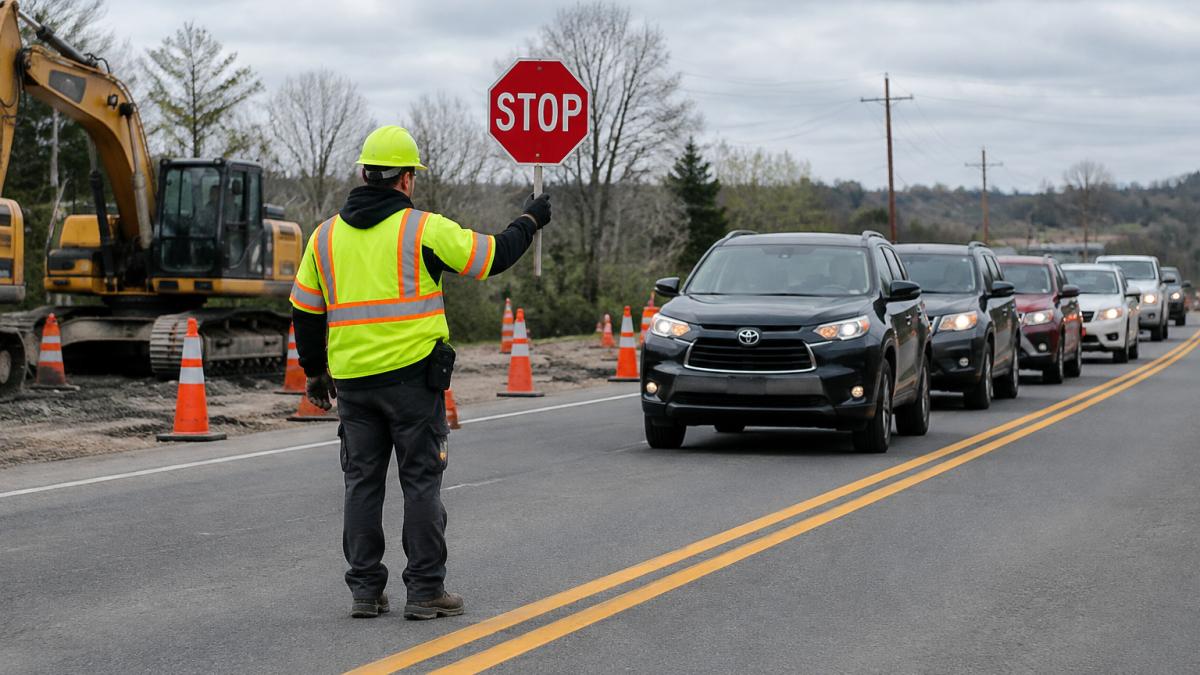
On a multi-lane highway, flaggers often work alongside smart work zone setups with radar speed displays and portable signals. On a local roadway, the same crew may be managing driveway access for residents who need to get out during a utility repair. Readers who want more on flagging practice can browse our traffic safety blog archives.
Flagger Qualifications and How to Verify Them
Flagger qualifications are the credentials a worker must hold before controlling traffic on a public roadway, typically a recognized flagger certification card plus current training in work-zone safety and temporary traffic control. Verification is the buyer’s job, not the provider’s promise. Ask for the following before mobilization:
- Certification cards for every flagger assigned to your site
- The training provider and expiration date on each card
- Proof of current high-visibility apparel meeting the applicable standard
- A named supervisor responsible for the crew
- Written confirmation of how replacements are staffed if someone calls out
A common mistake is accepting a certificate of insurance as proof of training. Those are different documents covering different risks.
A Work Zone Safety Checklist for Project Managers
Work zone safety is the measurable outcome of planning, devices, training, and supervision working together. The Associated General Contractors of America’s 2026 highway work zone safety survey reports that 60% of highway construction firms had at least one car crash into their work zones, which is why the checklist below focuses on the items that prevent intrusion rather than the ones that look good in a binder.
- Temporary traffic control plan on site and matches the current phase
- Device spacing checked against posted speed limits
- Positive protection or barriers in place where required
- Flagger stations positioned with adequate sight distance
- Pedestrian traffic control route marked and maintained
- Night work supplemented with lighting and retroreflective devices
- Daily pre-shift walk of the work-zone access points
- Incident and near-miss log reviewed weekly
Run this checklist at the start of every shift, not once per project. Conditions change overnight.
What Drives the Cost of Traffic Control Services
Pricing for traffic control services is built from labor, equipment, and mobilization, and the daily benchmark from IBISWorld’s traffic control procurement report, $1,620 per day in 2026, is a market reference, not a quote.
The drivers interact rather than stack independently:
| Cost driver | What changes | How it shows up in a quote |
|---|---|---|
| Shift length | Day, night, weekend, or 24-hour coverage | Night and weekend shifts carry wage premiums and often a minimum call-out |
| Crew size | One flagger vs. multi-station setup | Priced per flagger-hour, so headcount multiplies across the shift |
| Device count | Signs, cones, barriers, arrow boards, lighting | Priced per device per day, with delivery and pickup charges separate |
| Mobilization | Planned vs. emergency or storm response | Emergency deployment typically carries a premium and a shorter notice window |
| Project duration | Single shift vs. multi-month | Longer terms may shift from daily rates to weekly or monthly structures |
| Site complexity | Lane width, speed limit, pedestrian routes, night work | More devices, more flaggers, and more supervision hours per shift |
A common pattern is that buyers compare daily rates when they should compare cost per completed phase.
When you request quotes, ask each provider to break out:
- Flagger-hours by shift and station
- Device quantities by type, with daily rental and delivery charges
- Mobilization and demobilization fees
- Emergency response terms and any minimum call-out
- Overtime and holiday rates
Watch out: a quote that lists only a daily rate hides the device and mobilization charges that often decide the final invoice. Ask for the same line items from every provider so the comparison is real.
Market conditions also affect availability and rate structure. Technavio’s traffic control services market forecast projects USD 10,955.7 million in growth between 2026 and 2030 at a 9.2% CAGR, and during peak construction season that demand tightens crew availability and can push emergency mobilization pricing higher.
How to Choose a Traffic Control Provider
Checking certifications and responsiveness is a common starting point. Almost none tell you how to verify either one, which is the actual work of choosing a traffic control provider. For more guidance and insights before deciding, browse the ALL Ways Safe blog.
Start with qualifications and insurance, because these are pass/fail before anything else matters:
- Flagger certification. Ask for a copy of each assigned flagger’s card, the training provider, and the expiration date. Confirm the card matches the state or agency credential required for the roadway, since recognition varies by jurisdiction.
- Insurance. Request a certificate of insurance naming your company and the project owner as additional insured, and confirm the general liability and auto liability limits meet the contract’s requirements. A certificate of insurance is not proof of training, and training cards are not proof of insurance, collect both.
- Safety process. Ask for the provider’s written safety program, its incident and near-miss reporting procedure, and how quickly it notifies you of a work-zone intrusion.
- Plan capability. Ask whether the provider builds phase-specific temporary traffic control plans or only executes a plan someone else wrote. For multi-phase roadway work, planning depth separates a staffing vendor from a traffic control partner.
Then compare performance on measures you can verify rather than claims you cannot:
| Measure | What to ask for | How to verify |
|---|---|---|
| Response time | Documented mobilization window for planned and emergency work | Ask for a sample dispatch log or references who used emergency service |
| Setup accuracy | How device placement is checked against the plan | Ask for the pre-shift inspection form and who signs it |
| Schedule adherence | On-time crew arrival rate | Request references from projects with similar shift patterns |
| Safety record | Incident and near-miss counts per project | Ask how they define a recordable incident and request a summary |
| Staffing reliability | Call-out coverage process | Ask for the named backup supervisor and the replacement timeline |
Watch out: a low bid often reflects fewer flaggers per shift or shorter device coverage, not a lower rate. Compare bids on identical scope, same crew count, same shift hours, same device list, or the cheapest number is meaningless.
Finally, match the provider to the project type. A crew that runs single-lane closures on low-volume local roads may not be set up for multi-lane highway work with smart work zone equipment, and a highway specialist may be overbuilt for a short utility repair.
Request a Traffic Control Quote for Your Next Project
A quote for traffic control services for road construction should itemize crew size, shift hours, device counts, and mobilization terms, not just a daily rate. Ask for it in writing, phase by phase, so you can compare providers on the same scope.
At ALL Ways Safe, we provide flagging and traffic control available 24 hours a day, 7 days a week, 365 days a year. We are certified by the Women’s Business Enterprise National Council as a woman-owned, family-operated business, and we specialize in smart work zones, detailed planning, and rapid emergency response. Get A Quote from ALL Ways Safe for your next roadway project.
Frequently Asked Questions
What services do traffic control companies provide for road construction?
Most providers supply trained flaggers, temporary traffic control devices such as signs, cones, and barriers, and the planning work behind a temporary traffic control plan. Some also handle equipment delivery, setup, and removal, plus 24/7 emergency response for storm damage or utility breaks. When comparing traffic control services, ask which of these are in-house and which are subcontracted, because that split affects both your schedule and who answers when something goes wrong at 2 a.m.
What qualifications should flaggers have?
Flagger qualifications typically include a recognized certification card, current training on the Manual on Uniform Traffic Control Devices (MUTCD), and documented refresher training. Ask to see certification cards and confirm the training provider. A provider that can produce credentials quickly for any crew member assigned to your site is a good sign. Also ask how flaggers are briefed on your specific plan, since a certified flagger who has never read your site layout is still a risk.
What factors affect the cost of traffic control services?
The main cost drivers are crew size, shift length, number of lane closures, equipment volume, night or weekend work, and how far the provider travels to reach your site. Emergency and storm response usually costs more than planned work. Pricing depends on the specific service package, so get a written quote tied to your scope.
How do I verify a provider’s safety record before hiring?
Ask for their OSHA recordkeeping summaries, experience modification rate, and any citations in the past three years. Request references from projects similar in size and traffic volume to yours. Work zone intrusions are a real risk, so ask specifically how a provider prevents them, such as through barrier placement, glare screens, and advance warning. A provider that answers with specifics rather than generalities is the one to shortlist.
