Quick Summary
Smart work zone planning uses connected technology such as traffic sensors, queue detection and dynamic message signs to give drivers real-time information about a work zone. Drivers can then choose alternate routes, which reduces backups and helps keep both motorists and crews safer.
- Traffic sensors, queue detection and dynamic message signs feed real-time information to motorists.
- ASCE cites rear-end collision reductions of up to 70% in active work zones, depending on the project.
- A separate industry benchmark reports a 45% reduction from strategically placed traffic monitoring systems.
- Sensor placement is the most common technical failure point, so walk the sight line before fixing a mount.
- A benefit-cost ratio above 1.0 is a common threshold for justifying a smart work zone deployment.
Table of Contents
- What Smart Work Zone Planning Means
- Safety Improvements and Collision Reduction
- Traffic Mobility and Congestion Management
- The Technology Behind Smart Work Zones
- Cost-Benefit Analysis and Implementation Challenges
- Staffing and Traffic Control Planning for Smart Work Zones
- Using a Work Zone Safety Toolbox Talk to Brief Crews
- Planning Your Next Smart Work Zone With ALL Ways Safe
- Frequently Asked Questions
What Smart Work Zone Planning Means
Last Updated: November 4, 2026
Smart work zone planning uses connected technology to give drivers and crews real-time information about a work zone before and during construction.
Smart Work Zone systems are defined by the American Society of Civil Engineers (ASCE) as technology deployments that provide real-time roadway information to better inform motorists, encourage alternate route usage and reduce driver frustration ASCE Library research on Smart Work Zone systems.
Michigan’s state safety data put the scale of the problem in perspective, with approximately 6,000 crashes recorded in work zones during 2025 Michigan Department of Transportation 2026 work zone safety release.
How Smart Work Zones Differ From Traditional Setups
Traditional work zones rely on static signage, fixed lane closures and a flagger’s judgment in the moment. Smart work zones add a data layer: detection, communication and adjustment in near real time. Traditional planning ends once the cones are placed. Smart planning keeps going while the work is underway.
Safety Improvements and Collision Reduction
Rear-end collisions are the crash type smart work zone systems target most directly.
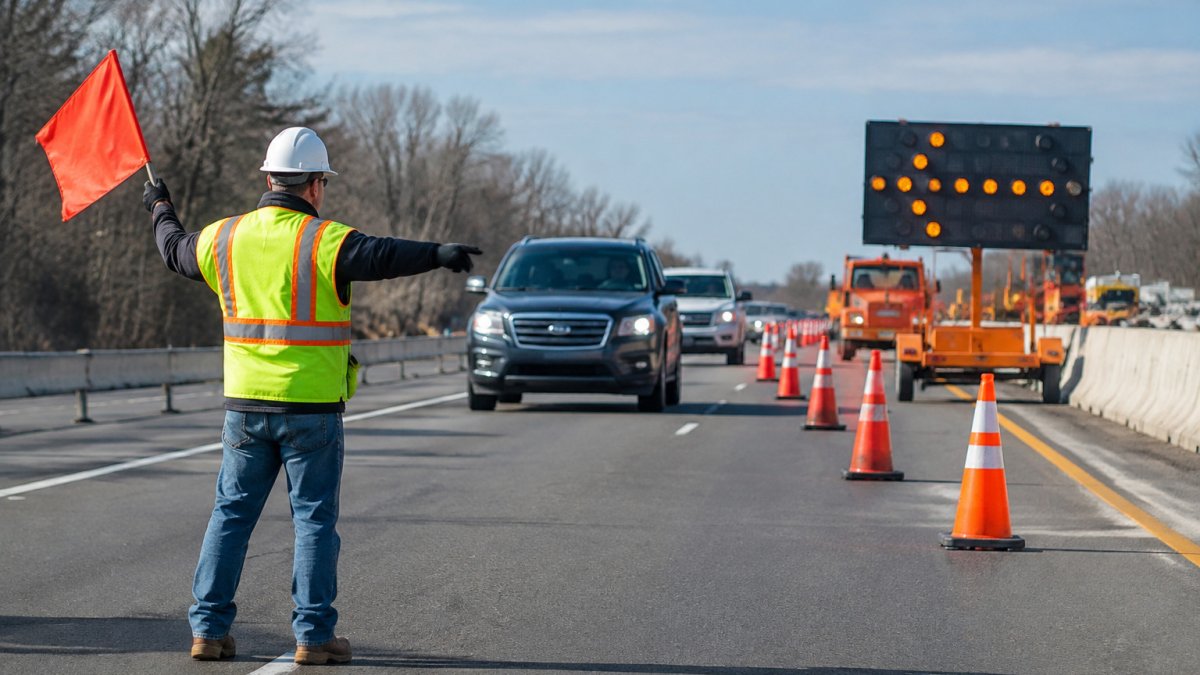
Reported results vary by deployment. The American Society of Civil Engineers (ASCE) cites reductions of rear-end collisions of up to 70% in active work zones ASCE report on Smart Work Zone deployment and layout.
Flagging remains part of the safety picture. A flagger in a high-visibility vest, working alongside a dynamic message sign, gives motorists two confirming signals instead of one.
Traffic Mobility and Congestion Management
Safety and mobility are linked. When drivers receive accurate travel information, they are more likely to use alternate routes, which lowers volume through the zone and reduces the stop-and-go that causes crashes.
The Federal Highway Administration (FHWA) documents deployments of Intelligent Transportation Systems that provide real-time data feeds and dynamic traffic management. Agencies reporting on these deployments describe improved traffic mobility, reduced congestion and enhanced safety for both workers and road users FHWA work zone Intelligent Transportation Systems resources.
Mobility gains depend on planning. Lane closure hours, detour routing and message sign content all need to match actual traffic patterns.
The Technology Behind Smart Work Zones
A smart work zone is a system, not a gadget. The components below are the ones most deployments rely on, and the value comes from how they hand data to each other rather than from any single device.
- Traffic monitoring sensors measure volume, speed and occupancy through the zone. Radar and inductive-loop sensors are common; some deployments use Bluetooth or Wi-Fi re-identification to estimate travel time between two points.
- Queue detection identifies slowdowns at the back of the line before they reach highway speed. This is the component that most directly targets rear-end crashes, because it buys the approaching driver seconds of warning.
- Dynamic message signs update travel times, lane status and detour guidance. Portable changeable message signs are the usual choice for short-duration work; permanent signs are used where the zone will last.
How the Components Work Together
The typical data path runs from sensor to controller to message sign, with a copy of the data going to the traffic management center. A queue detector that sees speeds drop below a threshold triggers a pre-scripted message on the sign upstream. The traffic management center sees the same event and can adjust the closure or dispatch a response. When the sign and the center disagree, drivers get conflicting information, which is worse than no information at all.
Integration With Intelligent Transportation Systems
The Federal Highway Administration maintains the ITS Joint Program Office and the National ITS Architecture, which describe how field devices, centers and traveler information services exchange data FHWA ITS Joint Program Office and National ITS Architecture.
The Transportation Research Board (TRB) has tracked research into connected vehicle data that could improve real-time management across these components TRB research on connected work zone technologies. Florida’s Department of Transportation has published design guidance to standardize how sensors and communication arrays are applied, which helps agencies avoid inconsistent deployments Florida DOT Smart Work Zone guidance.
Standards and Device Selection
Work zone traffic control devices are governed by the Manual on Uniform Traffic Control Devices (MUTCD), which sets the requirements for signs, signals and pavement markings on all public roads FHWA MUTCD.
Watch out: sensor placement is the most common technical failure point. A radar unit aimed at a curve or mounted too low will report speeds that do not match what drivers experience, and the sign will broadcast a queue that is not there.
Cost-Benefit Analysis and Implementation Challenges
Most guidance on smart work zones explains what the technology does and why it helps. Far less explains how a project manager actually justifies the spend or what to do when the system misbehaves in the field. This section takes both questions head-on, because the financial case and the operational reality are what determine whether a deployment succeeds.
Building the Cost Side
Smart work zone technology is not free, and the upfront investment is the main barrier for smaller projects and agencies. The Federal Highway Administration’s implementation guidance notes that advanced Intelligent Transportation Systems require significant initial spending and technical expertise FHWA work zone ITS implementation guidance. A realistic cost estimate should capture:
- Equipment purchase or rental (sensors, message signs, communication hardware, power)
- Installation, mobilization and demobilization labor
- Traffic management center staffing and monitoring hours
Rental arrangements can lower the upfront number for short-duration work, but they shift cost into a recurring line that is easy to underestimate over a multi-month project.
Building the Benefit Side
The U.S. Department of Transportation has promoted a Benefit-Cost Analysis framework so agencies can compare costs against safety and mobility gains on a consistent basis USDOT Benefit-Cost Analysis for Smart Work Zones. The framework is less important than the discipline of naming each benefit and attaching a value to it. The categories most practitioners use are:
- Delay costs avoided, the value of driver time saved when queueing is reduced, using a documented value-of-time figure
- Crash reduction, expected reduction in crash frequency multiplied by a documented crash cost
- Secondary benefits, reduced fuel consumption from idling, lower emissions, and fewer secondary incidents
Run the numbers on your own project: estimate delay costs avoided, expected crash reduction and equipment and staffing expense, then compare the totals. A benefit-cost ratio above 1.0 is a common threshold for justifying a deployment, and the ratio is sensitive to the value-of-time and crash-cost assumptions, so document them.
Implementation Challenges and Troubleshooting
Existing guidance tends to be optimistic about deployment. The field reality is messier, and the failure modes below account for most of the problems project managers report.
- Sensor placement errors produce false queues or missed queues. The fix is a sight-line walk and a calibration check against observed traffic before the system goes live.
- Message sign content that lags behind conditions erodes driver trust. If the sign says “no delay” while traffic is stopped, drivers stop believing the next message.
- Crews unfamiliar with the system treat it as a black box and stop using it after the first glitch. Assign one person to own the technology during the project and rehearse the response plan before mobilizing.
Watch out: the most expensive failure is a system that works but nobody watches. A smart work zone that is not actively monitored by a person empowered to act on the data is just an expensive set of signs.
The table below summarises the main cost and failure points the article identifies for smart work zone deployments.
| Area | Issue | Article guidance |
|---|---|---|
| Upfront spending | Significant initial investment and technical expertise needed | Estimate equipment, installation and training costs |
| Rental costs | Recurring line easy to underestimate over months | Track rental costs across the full project |
| Benefit-cost ratio | Common threshold for justifying deployment | Above 1.0, sensitive to value-of-time and crash-cost assumptions |
| Sensor placement | Most common technical failure point | Walk the sight line and calibrate against observed traffic |
| Message sign content | Lagging messages erode driver trust | Keep sign content synced with actual conditions |
| Connectivity and power | Failures take the system down silently | Run a daily check and keep a static-signage fallback |
| Monitoring | Unwatched system becomes expensive signage | Assign a person empowered to act on the data |
Staffing and Traffic Control Planning for Smart Work Zones
Technology does not replace trained personnel. Smart work zones still need flaggers who can respond when sensors fail, a message sign shows the wrong information or a crash occurs. Plan staffing around the work zone layout, not just the number of lanes closed.
Our planning process covers:
- Reviewing traffic volumes and peak periods for the corridor
- Identifying access points, detour routes and sight-distance limits
- Matching flagger positions to the sensor and message sign layout
- Setting a backup staffing plan for absences or emergency response
Clients who have experienced a flagger no-show know how fast a schedule can unravel. Build redundancy into the crew plan from the start.
Using a Work Zone Safety Toolbox Talk to Brief Crews
A short toolbox talk before each shift keeps everyone aligned on the day’s work zone configuration. Cover the lane closure pattern, the message sign content, the sensor locations that matter for that shift, and the emergency stop procedure. Ask each crew member to repeat back their position and their responsibility. Five minutes of briefing is cheap insurance against confusion once traffic starts moving.
Planning Your Next Smart Work Zone With ALL Ways Safe
Smart work zone planning works best when the plan is built before the first cone goes down. ALL Ways Safe provides 24/7 professional flagging and traffic control across the Mid-Atlantic, including detailed planning for smart work zones and rapid response for storm and emergency work.
Ready to plan your next smart work zone? Get A Quote and let us map your access points, staffing needs and traffic control plan before mobilization.
Frequently Asked Questions
What are the five areas of a work zone?
A typical work zone is commonly divided into five areas: the advance warning area, the transition area, the activity area, the buffer space, and the downstream taper with termination area. Each area has a defined purpose under the Manual on Uniform Traffic Control Devices (MUTCD). Smart work zone planning maps these areas before the project starts so that sensors, message signs, and flaggers are placed where they will do the most good for drivers approaching the site.
What is the purpose of traffic control in a work zone?
Traffic control in a work zone guides drivers safely through a changing roadway, protects workers in the activity area, and keeps traffic moving with minimal disruption. It includes signs, channelizing devices, flaggers, and, in smart work zones, real-time information systems. Well-planned traffic control helps reduce rear-end collisions.
How does smart work zone planning improve driver safety?
Smart work zone planning gives drivers advance information about queues, lane closures, and travel times, so they can slow down or choose alternate routes before reaching the site. Early warning reduces sudden braking, which is the most common cause of the rear-end crashes that make work zones dangerous for both motorists and crews.
How do intelligent transportation systems reduce congestion in construction zones?
Intelligent transportation systems (ITS) use sensors, queue detection, and dynamic message signs to measure traffic flow and share conditions with drivers in real time. Federal Highway Administration deployments show that this data supports dynamic traffic management, which improves mobility and reduces congestion. Agencies can adjust signal timing, recommend alternate routes, and respond to incidents faster than fixed signage allows.
Is smart work zone planning worth the upfront cost?
Smart work zone systems require meaningful upfront investment in sensors, communication equipment, and technical expertise, and that cost can be a barrier for smaller projects. The U.S. Department of Transportation has developed benefit-cost analysis frameworks to evaluate these deployments. Comparing projected reductions in crashes, delay, and crew exposure against equipment and staffing costs gives project managers a defensible basis for the decision. Pricing for ALL Ways Safe services depends on project scope, schedule, and staffing needs, so contact the company directly for a current quote.
