Last Updated: November 8, 2026
Quick Summary
A road construction safety protocol checklist starts with pre-work planning: assess hazards, assign named roles, and build a written work zone traffic control plan before crews mobilize. Run a daily inspection at shift start, after any layout change, and before night work, recording each item as pass or fail with a named owner for fixes.
- Warning signs belong 4 to 8 times the speed limit away in urban areas and 8 to 12 times in rural ones.
- Control measures follow a fixed order: remove the hazard, separate people from it, then protect with equipment.
- Keep the advance warning area, transition area, and work area distinct, with physical separation between traffic and workers.
- Position flaggers where drivers can see them from a safe stopping distance, never in a live lane.
- Every incident, including near misses and vehicle intrusions, gets a written record the same shift.
Table of Contents
- Road Construction Safety Protocol Checklist: Pre-Work Planning
- Road Construction Hazards and Control Measures
- Building a Work Zone Traffic Control Plan
- Flagger Qualifications, Positioning, and Visibility
- Personal Protective Equipment for Road Construction Crews
- Daily Construction Site Safety Inspection Checklist
- Construction Safety Checklist Template by Project Phase
- Emergency Response, Incident Reporting, and Adverse Conditions
- Frequently Asked Questions
Road Construction Safety Protocol Checklist: Pre-Work Planning
A road construction safety protocol checklist starts before the first cone hits the pavement. According to the Institute for Transportation’s Temporary Traffic Control Handbook, warning signs belong 4 to 8 times the speed limit away in urban areas and 8 to 12 times in rural ones. That math only works if someone planned it. Crews that plan first tend to finish safer and faster. Below, we break down exactly what to check before mobilization.
Road construction safety is the set of decisions, controls, and checks that protect workers, drivers, and pedestrians in and around an active work zone. Good planning turns those decisions into a written record.
Hazard Assessment and Site Access Review
Walk the site before you write a single control measure. Note traffic volume, speed, sight lines, and every entry point. List overhead lines, drop-offs, and blind corners. Then ask two questions: how do vehicles enter, and how do workers enter? If those paths cross, you have your first hazard.
Role Assignments and Sign-Offs Before Mobilization
Every checklist item needs a name attached. Assign a competent person for the site, a traffic control supervisor, and a spotter for equipment moves. Each one signs off on their section before crews mobilize. Unsigned boxes are open risks, not paperwork delays.
Road Construction Hazards and Control Measures
The four hazards that cause most work-zone injuries are traffic intrusion, backing equipment, falls, and struck-by incidents. Control measures follow a fixed order: remove the hazard, separate people from it, then protect with equipment. Cones and vests come last, not first.
Match each hazard to a control:
- Traffic exposure: lane closures, buffer space, and reduced speed limits
- Backing vehicles: spotters, backup alarms, and defined travel paths
- Falls: guardrails, covers, and fall protection at height
- Struck-by: high-visibility clothing and hard hats
A 2024 study on road work site safety management found that safety measures affect both workers and their surrounding environment. That is the point: controls protect the crew and the public at once.
Building a Work Zone Traffic Control Plan
A work zone traffic control plan is a written diagram of how traffic moves through and around your site. It shows signs, cones, barriers, flagger stations, and buffer zones. Every crew member should be able to read it.
Build the plan in this order:
- Set the work duration and road type
- Choose the lane closure or shift strategy
- Place warning signs at the correct distance
- Define tapers, buffers, and work-area separation
- Mark flagger stations and escape routes
Warning Signs, Markers, Cones, and Barriers
Signs give drivers time to react. Cones guide them. Barriers stop them. Use the 4-to-8 and 8-to-12 speed-limit rule for sign spacing, then check that no sign hides behind a curve or parked truck. Damaged cones and faded markers come off the truck, not onto the road.
Work-Zone Layout and Work-Area Separation
Keep three zones distinct: the advance warning area, the transition area, and the work area. Physical separation between traffic and workers is the strongest control you have. When space allows, a positive barrier beats a cone line every time.
Flagger Qualifications, Positioning, and Visibility
A flagger needs three things: training, the right position, and full visibility. Untrained flagging is one of the fastest ways to create a serious incident.
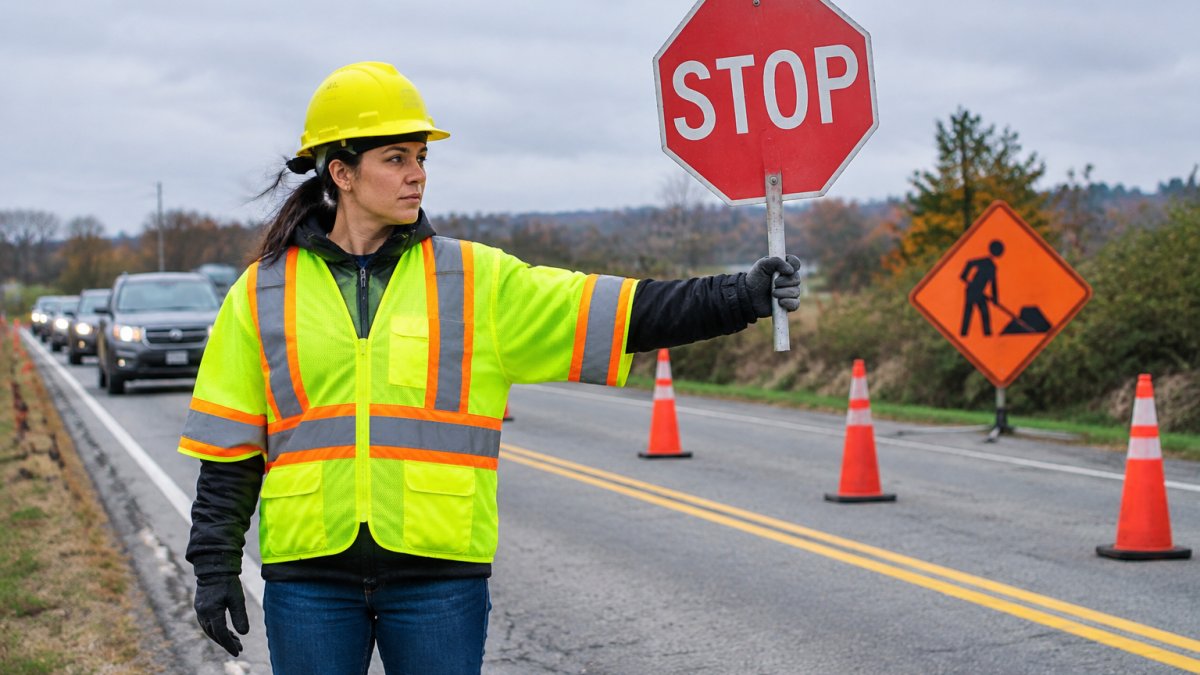
Position flaggers where drivers can see them from a safe stopping distance, never in a live lane. They need an escape route and a clear line of sight to each other. High-visibility clothing is mandatory, and so is a stop paddle that drivers can read at speed.
Training matters more than most crews admit. A flagger who understands traffic flow and speed reduction makes better calls in bad weather. If you staff flaggers through a provider, ask for proof of certification before the shift, not after.
Personal Protective Equipment for Road Construction Crews
PPE is the last line of defense, and it only works when it fits and gets worn. Set a minimum standard for every person on site:
- High-visibility vest or shirt, class matched to the road
- Hard hat in good condition
- Safety footwear with defined tread
- Eye and hearing protection near equipment
- Fall protection where work happens at height
Inspect gear daily. A cracked hard hat or torn vest is damaged equipment, and it gets replaced before the worker steps back into the zone.
Daily Construction Site Safety Inspection Checklist
A daily construction site safety inspection checklist is a short, repeatable walk that confirms every control still works. Run it at shift start, again after any layout change, and once more before night work or a weather shift.
Use this inspection sequence and acceptance criteria:
- Signs: upright, legible, not obscured by vegetation, parked vehicles, or curves; spacing matches the traffic control plan. Fail if any sign is down, faded, or hidden from the driver’s approach.
- Cones and barriers: in place per the plan, none crushed, faded, or displaced. Fail if a cone line has a gap wider than the plan allows or a barrier is out of alignment.
- Flagger stations: visible from a safe stopping distance, escape route clear, line of sight between flaggers intact. Fail if a station sits in a live lane or a flagger cannot see the next station.
- PPE: every worker on site wears the required high-visibility class, hard hat, and footwear. Fail if any worker is missing a required item or wearing damaged gear.
- Equipment: backup alarms, lights, and horns functional; no leaks or damaged guards. Fail if an alarm does not sound or a light is out.
- Access points: controlled, signed, and clear of debris. Fail if an uncontrolled entry lets vehicles or pedestrians into the work area.
- Traffic flow: matches the plan; no unexpected queuing or lane shifts. Fail if observed flow diverges from the diagram.
Record each item as pass or fail with the time, the inspector’s name, and the corrective action. Assign every fail an owner and a due time, then re-inspect before the shift ends. A common pattern is to log failures but never close them; the closeout record is what proves the control was restored.
Watch out: a pass on the morning walk does not hold for the afternoon. Re-inspect after any layout change, after a vehicle intrusion, and whenever weather reduces visibility.
Inspection records protect the crew and support regulatory compliance later. Compromised equipment gets pulled immediately, not flagged for later. For more field guidance and updates, browse the ALL Ways Safe blog.
Construction Safety Checklist Template by Project Phase
Use this construction safety checklist template as your working document. Print it, assign owners, and sign off at each phase.
| Phase | Checklist Item | Owner | Sign-Off |
|---|---|---|---|
| Pre-work | Hazard assessment complete | Competent person | ☐ |
| Pre-work | Traffic control plan approved | Traffic supervisor | ☐ |
| Setup | Signs, cones, barriers placed per plan | Crew lead | ☐ |
| Setup | Flagger stations marked and visible | Flagger lead | ☐ |
| Active work | Daily inspection logged | Site supervisor | ☐ |
| Active work | PPE check completed | Crew lead | ☐ |
| Closeout | Equipment inspected and stored | Equipment lead | ☐ |
| Closeout | Incident and inspection records filed | Site supervisor | ☐ |
The Federal Highway Administration’s work zone resources include current fact sheets and data collections worth reviewing each season. Work-zone safety guidance from ConstructConnect’s contractor safety tips also stresses planning, controlled zones, and proper PPE, which is the same backbone this template follows.
Emergency Response, Incident Reporting, and Adverse Conditions
Emergencies in a work zone move fast. Rain cuts visibility, wind moves cones, and a layout that worked at noon may fail at dusk. Write the response plan before you need it, and post it where every worker can see it.
Set these in place before mobilization:
- Emergency contact list and route: post the nearest hospital route, the site address, and the names and numbers of the competent person, traffic control supervisor, and site safety lead. Confirm the route is passable with the current lane closure.
- Incident reporting chain: name who reports, who notifies, and who documents. Every incident, including near misses and vehicle intrusions, gets a written record the same shift.
- Stop-work triggers: define the conditions that halt work, such as lightning within a set radius, wind that displaces cones or barriers, visibility below a stated threshold, or a vehicle intrusion that compromises the buffer.
- Re-inspection step: after any layout change, weather event, or intrusion, re-run the daily inspection before work resumes.
When a driver enters the work zone, the flagger’s first job is worker safety, not traffic flow. Move workers clear, then address the vehicle.
Adverse conditions deserve their own trigger list. Night work requires a re-check of sign retroreflectivity and flagger visibility. Rain and fog call for a lower speed advisory and a check that tapers still read at distance.
Watch out: an emergency plan that lives only in a binder fails when the crew cannot find it. Post it at the access point and review it at the start of each shift.
Storms, staffing gaps, and shifting layouts test any plan. ALL Ways Safe provides 24/7 flagging and traffic control, certified by PennDOT and backed by detailed planning and smart work zone setup.
Frequently Asked Questions
What should a road construction safety checklist include?
A complete road construction safety protocol checklist covers pre-work planning and hazard assessment, traffic control plan development and review, work-zone layout and work-area separation, warning signs and barriers, flagger positioning and visibility, personal protective equipment, vehicle and heavy-equipment safety, and daily inspections. It should also name a responsible owner for each item, define pass/fail criteria, and include emergency response and incident reporting steps. Organizing items by project phase, from mobilization through demobilization, keeps the checklist usable in the field rather than a document that gets signed once and filed away.
How do you conduct a daily road construction site safety inspection?
Walk the work zone before crews begin and again before the layout changes. Use a daily construction site safety inspection checklist to verify sign placement, cone and barrier spacing, work-area separation, flagger visibility, PPE use, and equipment condition. Record pass/fail for each item, note damaged equipment for immediate replacement, and assign a corrective action with a deadline and owner for anything that fails. Keep the signed record on site.
How should traffic be controlled around a road construction site?
Traffic control starts with a work zone traffic control plan developed and reviewed before mobilization. The plan sets speed reduction, lane closures, sign spacing, and flagger positions. A common rule of thumb for warning-sign placement is 4 to 8 times the speed limit in urban areas and 8 to 12 times the speed limit in rural locations, per the Institute for Transportation’s Temporary Traffic Control Handbook. Use trained flaggers in high-visibility clothing, keep work areas physically separated from traffic, and update the plan whenever the layout changes or conditions deteriorate.
What are the main hazards in a road construction work zone?
The biggest hazards are traffic exposure, backing vehicles and heavy-equipment blind spots, falls, and struck-by incidents involving equipment and materials. Road construction hazards and control measures should be paired directly in your checklist: flaggers and barriers for traffic exposure, spotters and exclusion zones for backing vehicles, fall protection for elevated work, and high-visibility clothing plus hard hats and safety footwear for struck-by risk. Add adverse conditions such as rain, fog, and night work, which reduce visibility and change stopping distances, and review the pairings at each shift briefing.
