Last Updated: November 6, 2026
Quick Summary
Certified flagging services for municipalities supply trained flaggers who hold a valid certification card, and that card is the difference between a defensible work zone and a liability exposure. Verify each flagger’s current card through a public database, confirm the certification matches the project authority, and require the credential matrix with the bid.
- A flagger should hold a current certification from a recognized training body, verifiable on request.
- ATSSA maintains a searchable directory of certified roadway safety professionals for confirming status.
- Requirements vary by state and project authority, so map each flagger to the authorities they are cleared for.
- Confirm the vendor carries general liability and workers’ compensation coverage naming your municipality as additional insured.
- Emergency flagging needs crews that mobilize within hours and planned shift rotations to manage fatigue.
Table of Contents
- Why Municipalities Need Certified Flagging Services
- Flagger Certification Requirements Every Vendor Should Meet
- Building a Traffic Control Plan for Municipal Roadwork
- How to Hire Flaggers for a Construction Site: A Procurement Checklist
- Flagger Staffing for Emergency Road Closures and Storm Response
- Comparing Certified Flagging Providers on Cost, Coverage, and Accountability
- Requesting a Certified Flagging Quote for Your Next Municipal Project
- Frequently Asked Questions
Why Municipalities Need Certified Flagging Services
Public works departments run road maintenance, utility repairs, and bridge work on streets that never close.
That is why certified flagging services for municipalities have moved from nice-to-have to procurement requirement. Insurers ask for certification records after an incident, and contract language increasingly demands them up front.
Most agencies learn the hard way that certification and staffing are two different purchases. A training provider sells a card; a flagging contractor sells a crew that shows up at 5 a.m. with that card in hand. Confusing the two is the most common mistake in municipal procurement.
Below, we break down what to verify, how to plan a traffic control setup, and how to compare providers on the criteria that actually matter.
Flagger Certification Requirements Every Vendor Should Meet
At minimum, a flagger should hold a current certification from a recognized training body, and the vendor should be able to produce that card on request. The standard most agencies reference is the American Traffic Safety Services Association, whose flagger certification courses run in both online and in-person formats.
Start with the credential itself. What to verify before you sign:
- Current card with a visible expiration date. Certification validity periods vary by state and by training body, so confirm the specific term your jurisdiction requires rather than assuming a multi-year window.
- Training format documented. Classroom training and online training both exist; some agencies accept only one, and some project authorities require a proctored or in-person component for work on state routes.
- Verification access. ATSSA maintains a searchable directory of certified roadway safety professionals that lets employers confirm certification status directly.
Watch out: a vendor that emails a certificate PDF but cannot point you to a verification database is asking you to take their word for it. Ask for the database lookup instead.
The jurisdiction-matching workflow most vendors skip
Certification is not one national standard applied uniformly. Requirements vary by state and, within a state, by project authority, a state DOT project, a county road, and a locally administered street can each carry different flagger requirements. A crew certified for one authority is not automatically cleared for another, and agencies treating certification as a single checkbox discover the mismatch at the pre-construction meeting.
A practical verification workflow for a public agency looks like this:
- List every project authority you will touch this season. Include the state DOT, the county, any transit or utility authority with right-of-way jurisdiction, and your own municipal standard.
- For each authority, record the flagger requirement in writing. Note the accepted training bodies, the required format, the validity period, and any project-specific orientation the authority imposes.
- Map each deployed flagger to the authorities they are cleared for. A simple matrix, flagger name down the side, authority across the top, prevents the wrong crew from being dispatched to the wrong job.
- Confirm the vendor maintains that matrix and updates it on renewal. Ask to see it, not just to be told it exists.
- Re-verify at contract renewal and at each project kickoff. Credentials lapse mid-contract more often than agencies expect.
What the card does not prove
Beyond the card, flagger qualifications include physical stamina for long shifts in weather, clear communication with motorists, and familiarity with the specific work zone layout.
Two more checks belong in the file. First, confirm the vendor carries general liability and workers’ compensation coverage naming your municipality as additional insured, a lapsed policy is a credential problem even when every flagger card is valid. Second, ask how the vendor documents on-site orientation for each flagger at each new site, because a flagger who has never seen a particular intersection is a risk regardless of certification status.
For agencies issuing an RFP, put the verification requirement in the solicitation: require the vendor to submit the credential matrix and verification lookup method with the bid, and make ongoing compliance a contract term with a defined remedy for lapses.
Building a Traffic Control Plan for Municipal Roadwork
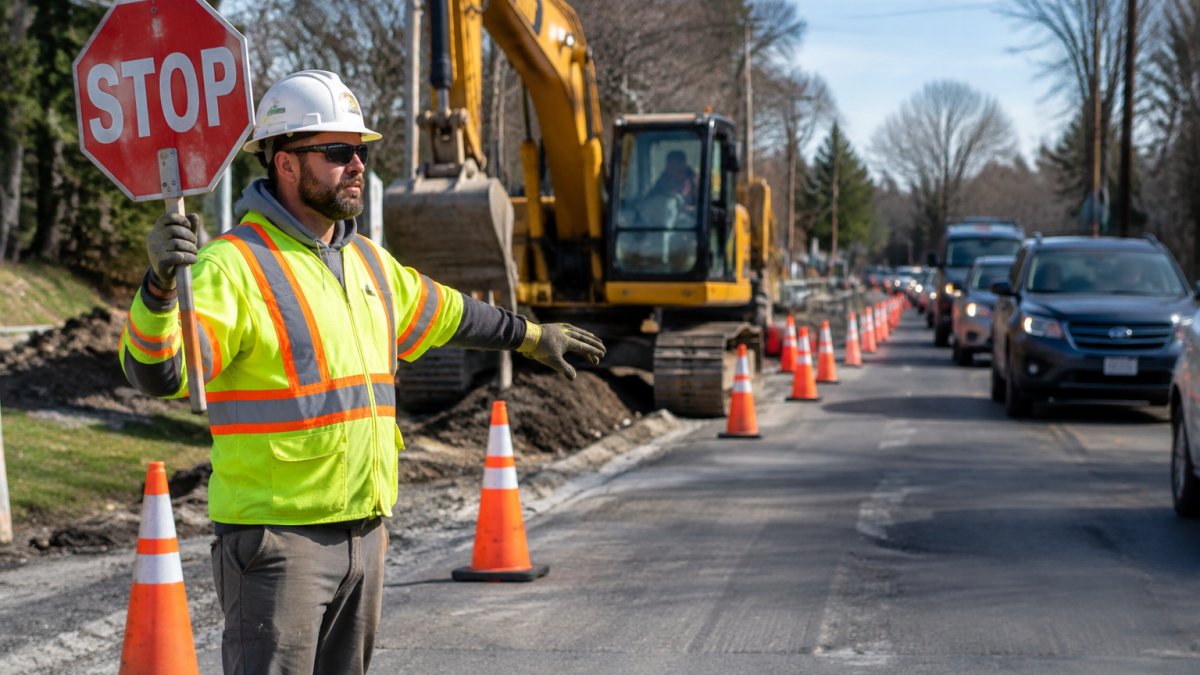
A traffic control plan is the site-specific document setting out how vehicles, pedestrians, and workers move safely through and around a work zone. It is not a generic template, it reflects lane widths, speed limits, sight distance, and work duration.
For municipal roadwork, the plan should cover:
- Temporary traffic control layout with cone placement, taper lengths, and buffer space
- Road closure and detour routing, including coordination with emergency services
- Flagger station assignments for each approach and each shift change
The Manual on Uniform Traffic Control Devices sets the national baseline for signage and work zone setup, and state DOT requirements layer on top of it.
Scoping the service: what the provider supplies and what you supply
A municipal traffic control plan is only as good as the division of labor behind it. Before the first cone goes down, settle in writing which party provides what.
- Provider supplies: certified flaggers, stop/slow paddles, high-visibility apparel, radios or other communication, and the flagger station assignments.
- Municipality supplies: the approved traffic control plan or the engineer who stamps it, the cones, barricades, signs, and arrow boards, and the right-of-way permissions.
- Either party, by agreement: variable message boards, portable lighting, and the traffic control supervisor who owns setup and takedown.
Ambiguity here is where budgets blow up. If the plan assumes the provider brings signs and the provider assumes the municipality does, the gap surfaces on mobilization morning. Put the equipment list in the scope of work and price it explicitly.
Lead times and scheduling by project type
Different municipal jobs need different planning horizons, and a provider quoting the same lead time for all of them is not planning your project.
- Scheduled street and utility repairs: submit the request with enough lead time for the provider to review the site and confirm crew availability; multi-week jobs benefit from a pre-construction walk.
- Bridge and structural work: longer lead times, because the plan is more complex and the flagger stations may need to change as the work phases advance.
- Special events and parades: plan around the event permit timeline, and confirm who controls pedestrian routing and intersection closures.
Who owns the plan when conditions change
What most guides miss: the plan is a living document. On a multi-week municipal street repair, traffic patterns shift as lanes reopen and close. Someone has to revise the plan mid-project. Ask your provider who owns that revision and how fast it happens.
Make the answer concrete: how a field change is documented, who approves it, and how quickly a revised setup can be deployed.
How to Hire Flaggers for a Construction Site: A Procurement Checklist
Hiring flaggers is a vendor qualification exercise, not a price-shopping exercise. The cheapest shift rate means nothing if the crew no-shows on a critical utility repair.
Use this checklist when evaluating any flagging services provider:
- Proof of current certification for every deployed flagger, verifiable in a public database
- Certificate of insurance naming your municipality as additional insured
- Written scope covering shift lengths, crew size, and site-specific planning
That last item matters more than it looks. When a water main breaks at 2 a.m., you need a phone answered by a person, not a voicemail box.
On pricing, expect cost to depend on shift length, crew size, travel distance, and whether the work is scheduled or emergency.
Flagger Staffing for Emergency Road Closures and Storm Response
Emergency road work breaks every assumption a planned project relies on: no lead time, no finalized traffic control plan, and often no clear picture of how long the closure will last.
Flagger staffing for emergency road closures needs three things: a crew that can mobilize within hours, a supervisor who can build a compliant setup on arrival, and enough depth to hold the site through a long shift rotation.
Storm response adds a fourth: fatigue management. Crews working 16-hour shifts in bad weather make mistakes.
Questions worth asking before you need them answered under pressure:
- How many crews can you deploy simultaneously within four hours?
- Who supervises an emergency setup when the standard plan does not fit the situation?
- How do you handle a closure that runs past 24 hours?
The real test is the deployment record.
Comparing Certified Flagging Providers on Cost, Coverage, and Accountability
Most provider comparisons stop at hourly rate. That is the least useful column in the table. Here is what we would actually compare:
| Criterion | What to Ask | Why It Matters |
|---|---|---|
| Cost structure | Per shift, per flagger, or per project? | Flat rates hide travel and overtime charges |
| Coverage area | Which counties and states are served? | Out-of-area crews add response time |
| Certification proof | Database lookup available? | Verifiable credentials protect the agency |
| Emergency response | Mobilization window in hours? | Storm response cannot wait on scheduling |
| Backup staffing | Documented no-show plan? | Protects your project schedule |
| Planning depth | Site-specific plan included? | Generic setups fail complex intersections |
| Accountability | Named contact, incident reporting? | Gives you recourse when service falls short |
On accountability, ask for the escalation path in writing: if a crew does not arrive, who do you call, and what is the remedy?
For agencies that want to read further into work zone practice before issuing an RFP, browsing our blog is a reasonable next step.
This is where we make our own case. ALL Ways Safe is certified by PENN DOT and operates 24 hours a day, seven days a week, 365 days a year.
Requesting a Certified Flagging Quote for Your Next Municipal Project
A useful quote request gives the provider enough to price the work accurately.
Include these details in your request:
- Project location, road type, and posted speed limit
- Expected duration and shift pattern
- Number of access points and approaches requiring flaggers
- Whether a traffic control plan already exists or needs development
A provider that responds with questions rather than a number is usually the one worth talking to.
Municipal budgets are tight, and we understand why a public works director scrutinizes every line.
If your next project needs a crew that shows up certified, planned, and on time, that is what we do.
Frequently Asked Questions
How can a municipality verify a flagger’s certification?
Ask the provider for each flagger’s training card and confirm the issuing body. ATSSA maintains a searchable database that lets employers verify certification status and find certified roadway safety professionals available for hire. Cross-check the card against that database before the crew arrives on site, and require the provider to supply updated cards whenever a flagger is substituted. This step catches expired credentials before they become a compliance problem on an active work zone.
Do flaggers have to be certified?
Certification requirements vary by state and by the agency funding the project. Many state DOTs and municipal contracts require flaggers to hold a recognized certification, often through a course aligned with MUTCD temporary traffic control standards. Even where certification is not explicitly mandated, public works departments typically require proof of training before allowing a crew onto a right-of-way. Confirm the specific requirement in your jurisdiction and put it in writing in the contract.
What should municipalities look for when hiring a flagging service?
Check four things: verified certification for every flagger, documented traffic control planning, crew availability and backup staffing, and a clear pricing structure per shift. Ask how the provider handles no-shows, how quickly it can mobilize for emergency road closures, and whether it carries the insurance your procurement office requires. A provider that answers these questions with specifics, rather than reassurances, is the one worth shortlisting.
How many flaggers does a municipal work zone need?
The count depends on the traffic control plan: lane configuration, traffic volume, sight distance, and whether the work is on a two-lane road with alternating flow. A single-lane closure on a low-volume street may need one or two flaggers, while a multi-access site with heavy traffic can require a larger certified crew plus a traffic control supervisor. Have the provider walk the site and produce a written plan rather than estimating crew size over the phone.
