Last Updated: November 15, 2026
Quick Summary
To coordinate traffic control during an emergency road closure, stop or slow approaching traffic first, then set advance warning and protect the hazard. Name one scene owner and one traffic control lead, confirm emergency responder access, and start the notification chain to dispatch, 511, and navigation feeds within the first 15 minutes.
- Advance warning for an urban incident typically goes back 100 to 350 feet depending on the posted speed.
- Detour setup order is signs first, then channelizing devices, then barricades.
- Post the closure to your state’s 511 system and any navigation apps your agency feeds.
- Partial reopening often beats a full one when one lane is safe and the hazard is confined.
- Track setup time, queue length, delay, crashes, and notification speed to review the response.
Table of Contents
- Emergency Road Closure Traffic Control: The First 15 Minutes
- Building a Temporary Traffic Control Plan for the Incident
- Who Runs the Scene: Incident Command and Interagency Decision Authority
- Setting Up Detours, Signing, and Traffic Control Devices
- Road Closure Notification: Alerting Drivers, Responders, and the Public
- Road Closure Traffic Control Plan: Managing Pedestrians, Cyclists, and Accessibility
- Traffic Control Plan Template: What to Fill In Before the Next Callout
- Deciding When to Reopen and What to Review Afterward
- Frequently Asked Questions
Emergency Road Closure Traffic Control: The First 15 Minutes
An emergency road closure rewards speed, but speed without order creates a second incident. The first 15 minutes decide whether the scene stays controlled or spirals. This guide explains how to coordinate traffic control during an emergency road closure, from the first call to the final reopening decision.
The opening moves are simple, and they must happen in order.
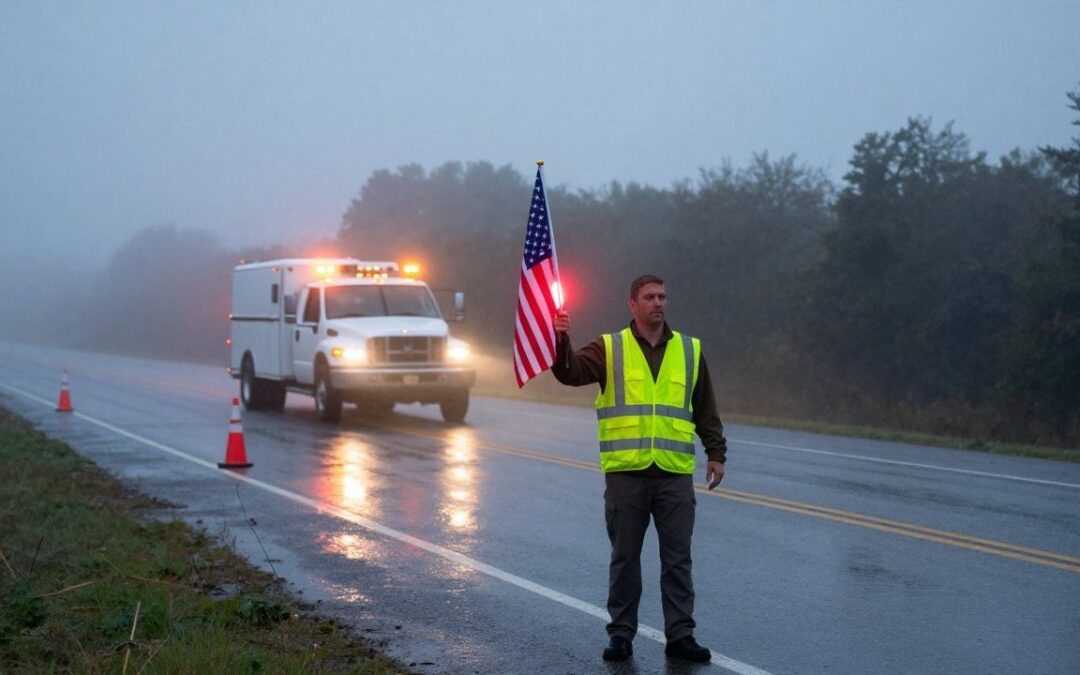
Minute 0-2: Confirm the call and stop traffic. The first person on scene, often a patrol officer or a utility crew, slows or stops approaching traffic before doing anything else. A vehicle positioned to block the lane, emergency lights on, is faster than cones and buys time. Radio dispatch with the location, direction affected, and an initial estimate of closure length.
Minute 2-5: Protect the hazard and set advance warning. Place cones and barricades around the hazard, then work backward to the first advance-warning sign. Under the Manual on Uniform Traffic Control Devices, advance warning for an urban incident typically goes back 100 to 350 feet depending on the posted speed; on higher-speed roads the distance grows. Put the sign where drivers still have room to react, not at the closure point.
Minute 5-8: Confirm emergency responder access. Ask the incident commander which lane or approach fire and EMS need. A closure that blocks the ambulance route turns one incident into two. Keep one lane or a marked access path open for responders and mark it so arriving units can find it.
Minute 8-12: Name the scene owner and the traffic control lead. One person commands the scene; one person owns traffic control. In a multi-agency response the ranking fire or law enforcement officer is usually in command until a formal handoff. Say the roles out loud and write both names down.
Minute 12-15: Start the notification chain. Radio the closure to dispatch and the traffic management center so incoming units route around it. Post to the state 511 system and any navigation feed your agency controls. For a closure expected to last more than an hour, push a short public notice through social media and local media.
Get these steps right and everything after them gets easier. Skip one and you spend the rest of the day fixing it.
Building a Temporary Traffic Control Plan for the Incident
A temporary traffic control plan for an unplanned closure is a short, written sketch of how traffic moves around the incident. It does not need to be long. It needs to be clear enough that a flagger arriving at 2 a.m. can follow it.
Build it in four parts:
- Closure limits: Which lanes, which direction, and which intersections are affected.
- Advance warning: Where the first warning sign goes, measured back from the closure.
- Detour route: The alternate path, including turns and any low-clearance or weight limits.
- Contingency plan: What changes if the closure lasts past shift change or spreads.
The Manual on Uniform Traffic Control Devices sets the national standards for signs, signals, and barricades. State and local rules build on it, so check your own jurisdiction’s supplement before you sign off.
Who Runs the Scene: Incident Command and Interagency Decision Authority
One person must own the scene. In a multi-agency response, that is usually the ranking fire or law enforcement officer until the incident commander hands off. Traffic control personnel take direction from that authority, not from whoever calls loudest.
Decision authority breaks down like this:
| Decision | Who Decides | Who Advises |
|---|---|---|
| Scene safety and evacuation | Incident commander | Fire, hazmat |
| Lane and road closure limits | Incident commander | Traffic control lead |
| Detour route selection | Traffic control lead | Public works, police |
| Reopening the road | Incident commander | Traffic control lead, DOT |
Interagency coordination works when roles are named out loud in the first few minutes. Ask who is in command. Ask who owns the detour. Write both down.
Setting Up Detours, Signing, and Traffic Control Devices
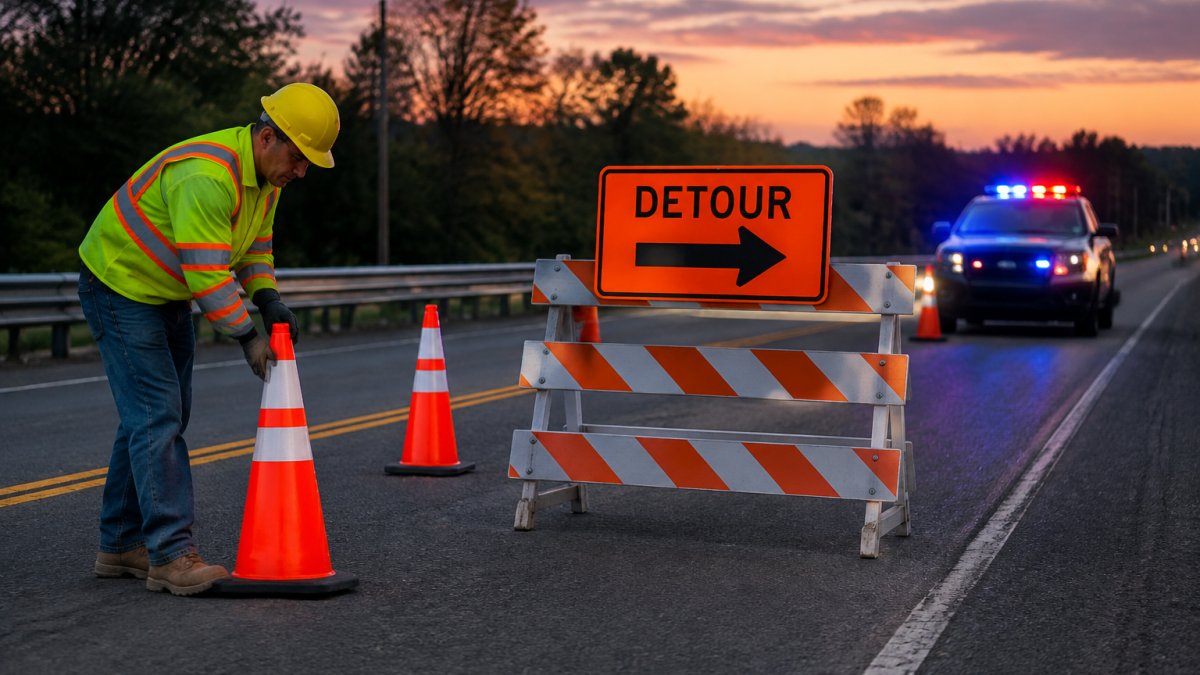
Detour setup follows a set order: signs first, then channelizing devices, then barricades. Drivers need advance warning before they reach the turn, not at it.
The device lineup for most closures:
- Warning signs placed well ahead of the closure
- Traffic cones to channel vehicles away from the work area
- Type III barricades across the closed lanes
- Arrow boards in directional mode to steer traffic
Signal work matters too. A signal facing a closed lane can run red-flash operation to slow traffic, and signal preemption lets emergency vehicles move through without waiting. Keep the detour route clear of parked cars and construction debris, or the detour becomes its own bottleneck.
Road Closure Notification: Alerting Drivers, Responders, and the Public
Road closure notification runs on three channels at once: responders, drivers, and the public. Start all three early.
- Responders: radio the closure to dispatch and the traffic management center so incoming units route around it.
- Drivers: post to your state’s 511 system and any navigation apps your agency feeds.
- Public: send a short notice through social media and local media for long closures.
A notification template saves time. Fill in the blanks:
ROAD CLOSURE: [street name] between [cross street] and [cross street] is closed due to [reason]. Detour via [route]. Expected duration [time]. Updates at [channel].
Keep updates on a schedule. One clear update every hour beats a flood of vague posts.
Road Closure Traffic Control Plan: Managing Pedestrians, Cyclists, and Accessibility
A road closure traffic control plan that ignores pedestrians creates new hazards. Pedestrian movement needs a defined path around the closure, separated from vehicle traffic with cones or barricades.
Accessible routing matters most here. A detour that works for cars may block a sidewalk, a curb ramp, or a bus stop. Check for:
- A continuous accessible path around the work zone
- Temporary curb ramps where the sidewalk is closed
- Advance notice to transit agencies about moved stops
- Clear signage for cyclists, who often share the detour with cars
Special-needs considerations are not optional. Hospitals, schools, and senior centers on the detour route may need direct notification.
Traffic Control Plan Template: What to Fill In Before the Next Callout
A traffic control plan template turns a chaotic callout into a checklist. Fill it in before the next emergency, and update it on scene.
- Incident location and closure limits
- Incident commander name and contact
- Advance warning sign locations
- Detour route with turns and restrictions
- Device list: cones, barricades, arrow boards
- Pedestrian and accessible path
- Notification channels and contacts
- Reopening criteria and reviewer
Our team keeps templates ready for every job, and you can browse more practical guidance on our blog between callouts.
Deciding When to Reopen and What to Review Afterward
Reopening is a decision, not a reflex. Set the criteria before the closure starts so the call does not depend on who is tired and who wants the road back. Most agencies use a short verification checklist, and the incident commander signs off only after every line is confirmed.
Reopening verification checklist:
- The hazard that caused the closure is cleared or made safe
- The roadway has been swept and inspected for debris, fluids, and damaged pavement
- Any damaged signs, signals, or pavement markings have been restored or temporarily replaced
- The incident commander has released the scene
- The traffic control lead has walked the closure limits and confirmed no devices remain in live lanes
- The notification chain has been told the road is reopening
Partial reopening often beats a full one. If one lane is safe, open it and keep the rest closed. The triggers for a partial reopen are practical: the hazard is confined to one side of the roadway, the open lane has adequate width and no conflicting work, and the remaining closure can be protected with channelizing devices rather than a full barricade line. When you make that change, reset the signs and cones so drivers read the new pattern correctly, a sign that still says “road closed” over an open lane is its own hazard. Move the advance-warning signs to match the new taper, and update the 511 and navigation feeds at the same time.
Afterward, review the response with measurable inputs, not impressions. Track the numbers that tell you whether the plan worked:
- Setup time: minutes from first notification to first advance-warning sign in place
- Queue length: peak backup distance and duration
- Delay: estimated vehicle-hours of delay, or average delay per vehicle if your traffic management center can pull it
- Crashes and near misses: any secondary incidents within the closure limits
- Notification speed: time from closure to 511 and navigation-feed posting
Compare those numbers against your past closures of similar size. A pattern of long setup times points to staging or staffing; a pattern of long queues points to detour routing or signal timing. Feed the findings back into the template and the first-15-minutes sequence so the next callout starts from a better plan.
An emergency road closure tests every part of your traffic control operation at once. ALL Ways Safe supports crews with 24/7 flagging and traffic control, rapid emergency and storm response, and detailed planning for smart work zones. Our certified team helps you keep the public safe and the job moving. Get started with ALL Ways Safe and put a trained crew on scene when minutes matter.
Frequently Asked Questions
What are the five main components of a temporary traffic control zone?
The five components are the advance warning area, transition area, buffer space, work area, and termination area. In an emergency road closure, these zones are compressed but still required. Advance warning signs go up first so drivers have time to react, cones and barricades channel traffic away from the hazardous area, and the termination area returns road users to normal lanes.
How do you create a traffic control plan for an emergency road closure?
Start with a scene size-up to confirm the closure limits and whether a full or partial closure is needed. Then select the road closure traffic control plan layout that matches the road type, post advance warning signs and channelizing devices, and map the detour route with signs at every decision point. Document the setup on a traffic control plan template so the next shift can replicate it. Coordinate with law enforcement and the traffic management center before the first cone goes down.
What information should a road closure notification include?
A road closure notification should name the exact location and closure limits, the start time and expected duration, the detour route, and who to contact for updates. Include whether the closure is full or partial, which lanes are affected, and any pedestrian or accessibility impacts. Send it through the channels your audience actually uses: variable message signs, 511 systems, social media, local media, and direct notices to schools, transit agencies, and emergency responders.
Who should coordinate traffic control at an emergency scene?
The incident commander, usually the ranking fire or law enforcement officer, holds overall authority at the scene. Traffic control coordination is typically delegated to a traffic control supervisor who directs flaggers, device placement, and detour adjustments. On utility or construction incidents, the site supervisor works alongside that person. Clear interagency coordination prevents conflicting instructions, and one point of contact for the traffic management center keeps detour and signal changes consistent.
