Last Updated: November 9, 2026
Quick Summary
Small municipality traffic management solutions work best when towns under 50,000 people focus on three pieces: adaptive signal control at the two or three worst intersections, video or radar detection instead of embedded road loops, and a written work zone plan tied to MUTCD standards. Cloud-based monitoring lets one person watch several signals, and connected vehicle systems and full traffic management centers can wait.
- Towns under 50,000 people get the best return from adaptive signals, detection sensors, and a work zone plan.
- A single adaptive intersection pilot is the lowest-risk way to test adaptive logic.
- Signal retiming on existing equipment often reduces peak-hour delay without new hardware.
- Split projects into three phases so each fits a single budget cycle.
- Require a before-and-after report at 30 and 90 days in the contract.
Table of Contents
- What a Smart Traffic Management System Looks Like for a Small Municipality
- Smart Traffic Management System Examples That Fit a Small-Town Budget
- Traffic Signal Controllers: The Core of Adaptive Signal Control
- Traffic Control Equipment Rental vs. Buying for Municipal Work Zones
- Building a Municipal Traffic Management Plan That Holds Up
- Low-Cost and Non-Technology Ways to Reduce Congestion
- Funding Small-Town Traffic Improvements and Phased Procurement
- Getting Flagging and Traffic Control Support for Your Next Project
- Frequently Asked Questions
What a Smart Traffic Management System Looks Like for a Small Municipality
A smart traffic management system is a connected set of sensors, controllers, and software that adjusts traffic signals and shares traveler information in real time.
That definition matters because most vendors sell the full urban package. You do not need it.
Here is what actually fits:
- Adaptive signal control at the two or three worst intersections
- Video or radar detection instead of embedded road loops
- Cloud-based monitoring so one person can watch several signals
- A written work zone plan tied to the MUTCD traffic control standards
The rest, including connected vehicle systems and full traffic management centers, can wait. Below, we break down the options, the costs, and the trade-offs.
Smart Traffic Management System Examples That Fit a Small-Town Budget
Smart traffic management system examples for small towns look different from smart-city showcases. The realistic options are narrower, and the value comes from matching each option to a specific problem your town already has.
- Camera-based detection at one corridor. Cameras count vehicles and adjust green time. No road cutting, no lane closures. A common pattern is a two- to four-intersection arterial where one direction backs up every weekday morning. The trade-off is that cameras need a clear view and periodic lens cleaning, and some residents raise privacy questions that are best answered early with a written data-use policy.
- Radar sensors on mast arms. Radar handles rain, fog, and darkness better than cameras in many cases. It is a strong fit for a corridor with heavy truck traffic or frequent weather. The trade-off is that radar gives you presence and speed but not classification, so it is less useful if you need vehicle counts by type for planning.
- Cloud signal monitoring. A monthly software service that flags a broken detector before a resident calls. This is the highest-return option for a town with one public works employee who cannot visit every cabinet weekly. The trade-off is an ongoing subscription and a dependency on the vendor’s uptime; confirm the service-level terms before signing.
- Portable message boards. These double as work zone warning devices and event traffic tools. A town that runs a summer festival, a road race, and a handful of utility projects can justify one or two boards that serve all three. The trade-off is storage and battery maintenance between events.
- A single adaptive intersection as a pilot. Rather than upgrading a whole corridor, run adaptive control at the one intersection with the worst peak-hour delay and measure before and after. This is the lowest-risk way to test whether adaptive logic works with your staff and your traffic patterns.
Watch out: a common mistake is buying detection hardware before mapping which intersections actually cause delay. Towns often spend on the wrong corner.
Small-town use cases tend to cluster around a few patterns: a school zone that backs up twice a day, a Main Street with a handful of signals that are not coordinated, a freight route through a residential edge, and seasonal event traffic.
Traffic Signal Controllers: The Core of Adaptive Signal Control
Traffic signal controllers are the cabinet-mounted computers that run the lights at each intersection. Adaptive signal control means those controllers change timing based on live traffic instead of a fixed schedule (EDC-1: Adaptive Signal Control Technology).
The controller is where your money lands, so get this right. Older electromechanical controllers cannot run adaptive logic. Most towns need a modern controller plus compatible detection before adaptive timing works at all.
A practical upgrade path:
- Confirm the controller model and firmware at each intersection
- Check whether detection is loop-based or camera/radar
- Verify the controller can accept adaptive timing software
- Budget for cabinet upgrades where wiring is outdated
- Train one staff member on the signal timing software
What most guides miss is the staffing piece. Adaptive control still needs a person to review timing reports. Without that, the system runs on defaults and you paid for nothing.
Traffic Control Equipment Rental vs. Buying for Municipal Work Zones
Traffic control equipment rental usually beats buying for small municipalities, because most towns need cones, barricades, and arrow boards for short windows, not year-round.
Buying makes sense in a few cases. If your public works crew runs work zones most weeks, owning basic devices pays off. If you run two projects a year, renting is cheaper and simpler.
| Situation | Better Choice | Why |
|---|---|---|
| 1-3 short projects per year | Rent | No storage or upkeep |
| Year-round in-house crews | Buy basics | Frequent use, lower long-run cost |
| Emergency storm response | Contract provider | Crews and devices on short notice |
| Large event traffic | Rent | One-time need, no storage after |
Pricing depends on device count, duration, and delivery distance, so ask for a quote rather than guessing. For work zone planning support, browse our blog for guidance before you commit.
Building a Municipal Traffic Management Plan That Holds Up
A municipal traffic management plan is the written document that sets how your town handles signals, work zones, incidents, and events. It holds up when it names who does what, on which road, under which standard.
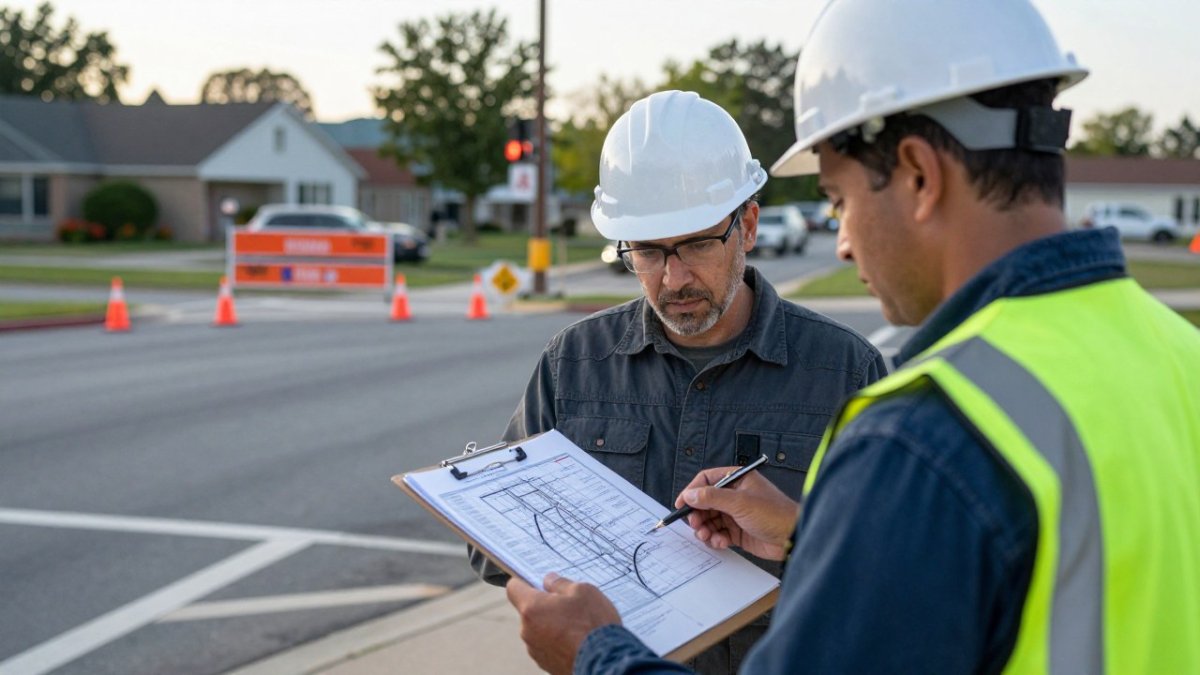
Start with the roads that hurt. List your five worst intersections by complaint volume and crash history. Then write, for each one, the fix, the owner, and the timeline.
Include these sections:
- Signal timing review schedule
- Work zone setup rules tied to MUTCD guidance
- Incident response steps and who calls whom
- Event traffic procedures for festivals and races
- Device inspection log for cones, barricades, and signs
The plan is also your funding document. Reviewers want to see priorities, not wish lists.
Low-Cost and Non-Technology Ways to Reduce Congestion
Not every fix needs a sensor. Some of the highest-return moves in small towns cost almost nothing and need no procurement cycle.
Signal retiming tops the list. A fresh timing review on existing equipment often reduces delay at peak hours without new hardware. Many towns run the same timing plan from a decade ago.
Other low-cost options:
- Restripe lanes to add a turn pocket at a bottleneck
- Adjust pedestrian walk intervals to reduce unnecessary vehicle stops
- Coordinate two adjacent signals on a timer
- Clear sight lines by trimming vegetation near signs
- Shift school and shift-change traffic patterns by a few minutes
A common mistake is chasing technology before trying timing. Towns sometimes buy detection hardware for an intersection that a retiming fix would have solved.
Funding Small-Town Traffic Improvements and Phased Procurement
Money is the real constraint, and phased procurement is how small towns get past it. Split the project into stages so each one fits a single budget cycle, and price each stage in categories a finance officer can defend.
A workable three-phase approach:
- Phase one: timing review and low-cost fixes on existing equipment. Typical cost categories are engineering time for the review, staff labor to implement new timing plans, and minor signing or striping. This phase often fits inside an existing operating budget.
- Phase two: detection and controller upgrades at the top two intersections. Cost categories are controllers, detection hardware, cabinet and wiring work, installation labor, and signal timing software. Get at least three quotes, because cabinet condition varies widely and drives the installation number.
- Phase three: cloud monitoring and expansion to the next corridor. Cost categories are the annual software subscription, communications (fiber, cellular, or both), and staff training. Treat the subscription as a recurring line item, not a one-time purchase.
Each phase produces a result you can show residents. That record helps when you apply for the next round of funding. Document before-and-after travel times and complaint counts.
On funding sources, small municipalities typically look at four places. The state transportation improvement program is the main capital channel for projects on state-owned roads. Regional planning organizations often administer federal planning and congestion-mitigation funds and publish call-for-projects schedules. State safety programs fund countermeasures tied to crash history, which is why your five worst intersections list matters. And local capital budgets or reserve funds cover the smaller phases that do not qualify for grants.
On procurement, three considerations decide whether a small project moves. First, confirm whether your purchase falls under formal bidding thresholds or can use a cooperative purchasing contract, which can shorten timelines considerably. Second, write specifications around outcomes, detection accuracy, controller compatibility, data ownership, and service-level terms, rather than around a single vendor’s product sheet. Third, build the evaluation into the contract: require a before-and-after report at 30 and 90 days so you have evidence for the next funding cycle.
Watch out: the most common failure is buying phase-two hardware before phase-one timing work is finished, which locks in a configuration before you know what the intersection actually needs. Sequence the phases and hold the purchase until the timing review is complete.
Getting Flagging and Traffic Control Support for Your Next Project
Even a well-planned system needs people on the ground when a work zone opens. That is where a certified traffic control partner earns its place.
ALL Ways Safe provides 24/7 professional flagging and traffic control across the Greater Tri-State and Mid-Atlantic regions. We are a woman-owned, family-operated business, certified by the Women’s Business Enterprise National Council. Our services include smart work zones, detailed planning, and rapid emergency and storm response.
If you run a small public works department, you can contact us about planned projects and emergency callouts. For current availability and pricing, request a quote through our website.
Small-town traffic problems rarely need a big-city system. They need a clear plan, a few smart upgrades at the worst intersections, and a reliable crew when the cones go out.
Frequently Asked Questions
What traffic management solutions are actually affordable for a small municipality?
Start with the low-cost layer: retiming existing signals, restriping lanes, clearing sight lines, and tightening work-zone layouts. From there, add adaptive signal control at your two or three worst intersections rather than citywide. Rent detection cameras and message boards for seasonal peaks instead of buying them. Most small municipalities get the biggest gain from a written municipal traffic management plan plus rented equipment for work zones, then invest in controllers and sensors only where queue length and travel time data show a real problem.
How do traffic signal controllers help manage congestion in a small town?
Traffic signal controllers set the timing plan at each intersection. Older fixed-time controllers run the same cycle all day, so they waste green time at 2 p.m. and starve the main road at 5 p.m. Modern controllers can run time-of-day plans and, with detection, switch to adaptive signal control that adjusts splits based on actual traffic volume. For a small municipality, upgrading controllers at two or three key intersections often reduces queue length and travel time more than a full system replacement.
Should we rent or buy traffic control equipment for municipal work zones?
Rent when the need is short or seasonal: a utility repair, a festival, a bridge project, or storm response. Rental spreads cost across the project and avoids storage, maintenance, and calibration. Buy only the items you use year-round, such as a set of cones, barricades, and signs. For traffic control equipment rental, confirm the provider delivers MUTCD-compliant devices, handles setup and pickup, and can mobilize fast for emergencies. Many small municipalities rent detection and message boards while owning only the basics.
How can a small municipality fund traffic management improvements?
Layer funding sources rather than chasing one big grant. Start with the municipal capital budget for signal controllers and detection at priority intersections. Add state and federal safety and congestion programs through your state DOT, plus regional planning organization suballocations. For work zones, build flagging and rental costs into each project’s traffic control budget instead of a separate line item. A phased municipal traffic management plan makes each request concrete and easier to justify to council and grant reviewers.
