Last Updated: November 17, 2026
Quick Summary
MUTCD flagger requirements are met by following the federal MUTCD, your state’s adopted edition and supplements, and employer rules, applying the stricter rule when they conflict. Verify training, apparel, paddle, and station setup against the edition your state has adopted before mobilization.
- Revision 1 of the 11th Edition took effect on March 5, 2026, so train against the adopted edition.
- Flagger-specific material sits in Chapter 6E of Part 6, Temporary Traffic Control.
- The 2009 MUTCD requires a STOP/SLOW sign at least 24 by 24 inches with 8-inch letters.
- A flagger card from one state does not automatically satisfy another state’s training rule.
- Run a pre-shift checklist covering paddle, apparel class, signs, sight distance, and escape route.
Table of Contents
- What MUTCD Compliance Means for a Flagger
- MUTCD Flagger Training Requirements
- Flagger Certification Requirements by Jurisdiction
- Equipment Standards: Apparel, Paddles, and Signs
- Flagger Station Setup Requirements
- Flagger Safety Checklist for Every Shift
- Night Work, Low Visibility, and Unusual Site Conditions
- Common Violations and the Legal Cost of Noncompliance
- Frequently Asked Questions
What MUTCD Compliance Means for a Flagger
MUTCD compliant flagger requirements start with one fact: the Manual on Uniform Traffic Control Devices is the national standard for every sign, signal, and flagger who controls traffic on a public road.
A flagger is a trained person who stops, slows, and releases traffic through a work zone using a paddle, sign, or hand signals. Compliance can be understood as three stacked layers, and many crews focus only on the first one.
Federal MUTCD, State Supplements, and Employer Rules
The federal MUTCD sets the floor, not the ceiling. States adopt it, then add their own supplements, and many add stricter rules for training and apparel.
- Federal layer: national device standards and flagging procedure
- State layer: adoption dates, supplements, and certification rules
- Employer layer: site-specific plans, PPE policies, and documentation
A flagger who meets the federal standard can still fail a state audit. Check all three before mobilization.
How to Resolve Conflicts Between the Three Layers
When the layers disagree, the stricter requirement generally controls, but the mechanism matters. The federal MUTCD is not self-enforcing; it binds through the state’s adoption and federal-aid conditions.
A practical resolution order that most practitioners follow:
- Read the project’s traffic control plan and special provisions first. They often name the controlling edition and any state supplement by section.
- Confirm the state’s current adoption. A state may be on the 11th Edition, an earlier edition, or the 11th Edition with a state-specific amendment. The state DOT’s official manual page is the authority, not a training vendor’s summary.
- Apply the stricter rule where the federal and state texts differ on a safety-critical item such as apparel class, paddle size, or flagger station sight distance, and document the choice in the traffic control plan.
- Treat employer policy as additive. An employer can require more than the state minimum but cannot waive a state or federal requirement.
Watch out: a flagger card from one state does not automatically satisfy another state’s training rule, and a project owner can reject a card that is valid elsewhere. Verify the card against the state where the work happens and the project’s special provisions before mobilization.
Where to Verify Each Requirement
The MUTCD is organized by part, and flagging requirements concentrate in Part 6, Temporary Traffic Control. The flagger-specific material sits in Chapter 6E, covering the flagger’s authority, clothing, hand-signaling devices, and station procedures.
A requirement-to-citation map keeps a supervisor from relying on secondhand summaries:
- Flagger clothing and high-visibility apparel: Chapter 6E, plus the ANSI/ISEA 107 standard it references.
- STOP/SLOW paddle and flag dimensions: Chapter 6E device provisions and the applicable sign chapter.
- Flagger station location and sight distance: Chapter 6E procedure text and the Part 6 typical application figures.
Because the 11th Edition and Revision 1 reorganized some Part 6 content, cite section numbers from the edition your state has adopted, not an older printing. When a state supplement renumbers or amends a section, cite the state section alongside the federal one so an inspector can follow the chain.
MUTCD Flagger Training Requirements
MUTCD flagger training requirements are not spelled out as one universal course in the federal manual. Instead, the MUTCD defines what a flagger must do, and states set the training and credential rules that prove it. That gap trips up contractors bidding across state lines.
What a Flagger Must Know Before Directing Traffic
Before a flagger touches a paddle, they need working command of:
- How to stop traffic and how to release it safely
- Correct paddle use and hand signal technique
- Where to stand for sight distance and an escape route
A common mistake is treating flagger training as a one-hour orientation. In practice, the flagger is the first person a driver sees and the last line of defense for the crew.
Flagger Certification Requirements by Jurisdiction
Flagger certification requirements vary by state, and no single renewal interval applies nationwide. The ATSSA state requirements resource tracks training rules across all 50 states, while some states publish their own intervals. One state engineering policy guide, for example, sets recertification every four years.
| Jurisdiction Layer | Who Sets It | What to Verify |
|---|---|---|
| Federal | FHWA / MUTCD | Device and procedure standards |
| State | State DOT | Training, card, renewal cycle |
| Employer | Contractor | Site plan, PPE, records |
Ask for the card, the issuing body, and the expiration date. Then confirm the card is valid in the state where the work happens.
Equipment Standards: Apparel, Paddles, and Signs
Equipment standards are where compliance becomes visible. A flagger in the wrong vest class or holding an undersized paddle can fail inspection before the first car stops. The requirements are specific enough to check with a tape measure and a garment label, so treat this section as an inspection list.
High-Visibility Apparel and ANSI/ISEA 107 Classes
Flagger apparel must meet ANSI/ISEA 107. The standard sorts garments by class based on the amount and arrangement of retroreflective material and the body area covered. Match the class to the conditions, not the budget.
A few field rules that follow from the standard:
- Check the label, not the color. A bright yellow-green shirt is not compliant unless the label states the ANSI/ISEA 107 class and the manufacturer’s certification.
- Inspect the retroreflective tape each shift. Cracking, dirt, and fading reduce performance even when the garment looks bright in daylight.
- Retire damaged garments. A torn vest or missing tape can drop effective coverage below the certified class.
A garment’s class is a property of the garment as certified, so a bright vest does not change class when layered over other clothing.
STOP/SLOW Paddles, Flags, and Warning Signs
The 2009 MUTCD specifies a STOP/SLOW sign at least 24 by 24 inches with letters at least 8 inches high, per the FHWA Chapter 6E flagger control text. The older 2003 text sets a flag at a minimum of 24 inches square. Verify the current edition before you buy.
The paddle is the flagger’s primary communication device, and its condition matters as much as its size:
- Face and legend: the STOP and SLOW faces must be clean, legible, and free of cracks or peeling. A faded SLOW face reads as a stop signal at distance.
- Handle and mounting: the handle must hold the paddle clear of the body and stay rigid in wind so the face does not twist away from drivers.
- Retroreflective sheeting: the paddle face should carry retroreflective sheeting so it reads at night and in rain. Check for dull spots during the pre-shift inspection.
Warning signs set the approach. The advance warning sign belongs upstream of the flagger station at a distance keyed to posted speed and road type, per the Part 6 tables. Two common placement errors are:
- Signs too close to the work zone. A driver who sees the warning sign late has no room to slow before the flagger’s stop point.
- Signs left in place after the shift. A warning sign that stays up overnight with no activity trains drivers to ignore the sign, and it can become a hazard on its own.
Matching Equipment to Conditions
The equipment list should change with the site, not stay fixed from job to job:
- Night work: Class 3 apparel or the state-accepted equivalent, retroreflective paddle sheeting in good condition, and lighting at the station so the flagger is visible against the background.
- Rain, fog, and low sun: confirm the paddle face and sign sheeting still read at approach speed, and consider a second advance warning sign where sight distance is short.
- Curves, crests, and intersections: the Part 6 typical application figures show the device layout for these geometries; do not improvise a layout the figures do not support.
Document the equipment check on the daily inspection log, including paddle size and condition, apparel class, sign placement distances, and the MUTCD edition the layout was built against.
Flagger Station Setup Requirements
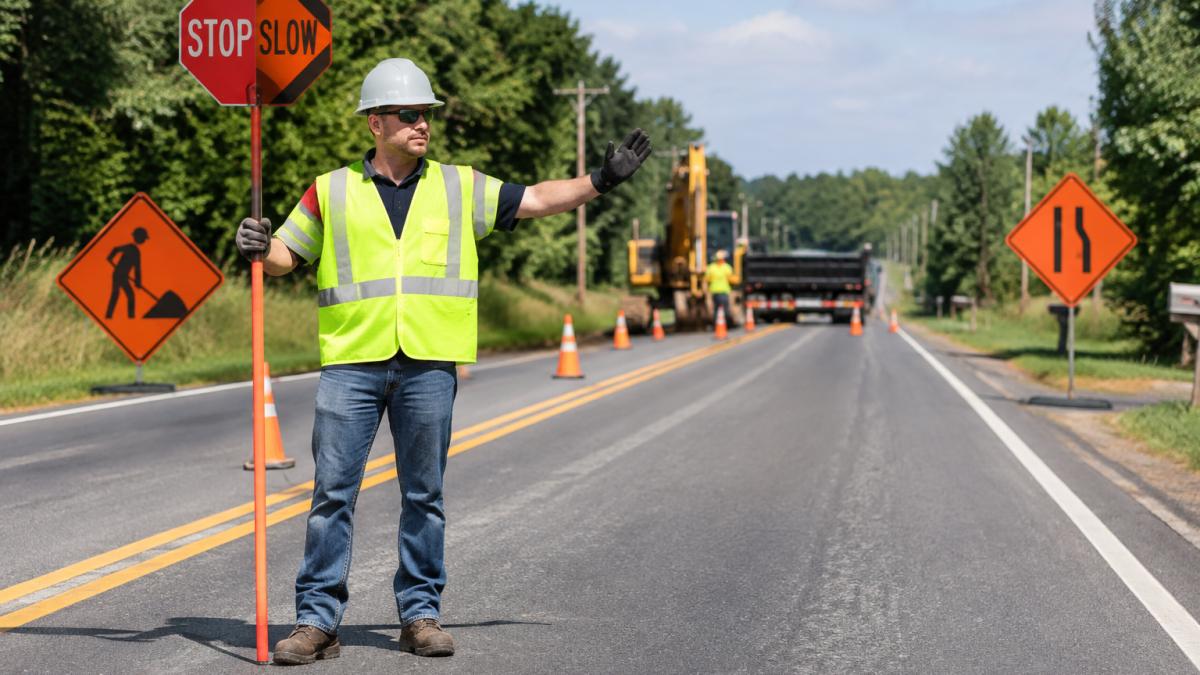
Flagger station setup requirements come down to three things: the flagger can see, be seen, and get out of the way. Get any one wrong and the station is unsafe no matter how good the paddle is.
Positioning, Sight Distance, and Escape Routes
Place the flagger ahead of the work zone with enough approach sight distance for the posted speed. Give them a clear escape path off the travel lane. Never station a flagger around a curve or over a crest where drivers cannot see the stop in time.
Flagger Safety Checklist for Every Shift
Run this before every shift. It takes five minutes and catches most violations.
- Paddle and backup flag inspected
- Apparel class matches day or night conditions
- Warning signs placed per the traffic control plan
Document the check. If an incident happens, that record is your proof of due care.
Night Work, Low Visibility, and Unusual Site Conditions
Night work raises the bar on every requirement. Retroreflective material becomes the difference between seen and invisible, and Class 3 apparel is the safer default. Add lighting at the station and check that signs stay legible at approach speed.
Unusual conditions need a fresh look at the plan:
- Heavy rain or fog: shorten the station spacing and slow releases
- Multiple access points: assign one flagger per conflict point
- Steep grades: extend the advance warning distance
Automated flagger devices can help on long, low-volume sites, but a human flagger still owns the decision.
Common Violations and the Legal Cost of Noncompliance
Noncompliance can carry costs beyond the bid sheet, including potential loss of federal-aid eligibility and liability exposure after an injury in a noncompliant zone.
Common violations include:
- Undersized or damaged STOP/SLOW paddle
- Wrong apparel class for night work
- Flagger standing in the travel lane with no escape route
- Signs placed too close to the work zone
Each one is cheap to fix before the shift and costly after a crash. For more on how we approach these situations, browse our safety and compliance articles or read the traffic safety archives covering real compliance cases.
Traffic control compliance is not a paperwork exercise. It is the difference between a crew that goes home safe and a work zone that becomes a statistic.
Frequently Asked Questions
What does MUTCD compliant mean for a flagger?
It means the flagger, the equipment, and the flagging operation meet the standards in the Manual on Uniform Traffic Control Devices plus any state supplement that applies. In practice that covers training, high-visibility apparel, a proper STOP/SLOW paddle, correct positioning, and clear communication with road users. Compliance is judged against the edition your state has adopted, so check the current edition and effective date before planning work-zone traffic control.
Does the MUTCD require flaggers to be certified?
The federal MUTCD sets flagger control standards but does not create a single national certification. Flagger certification requirements come from state agencies and employers. Some states set their own renewal intervals, so check your state’s official transportation agency for current requirements. Confirm your state’s rule and keep training records on site.
What minimum ANSI/ISEA 107 apparel class does the MUTCD require for flaggers?
The MUTCD requires flaggers to wear high-visibility apparel meeting ANSI/ISEA 107, and the class depends on site conditions. Class 2 is the common baseline for daytime work; Class 3 is used where speeds, traffic volume, or low visibility demand more conspicuous material. Match the class to the roadway and conditions, and inspect retroreflective material for wear before each shift.
What signs and equipment are needed for a flagger-controlled work zone?
At minimum, the MUTCD calls for a STOP/SLOW paddle and high-visibility apparel, along with advance warning signs and channelizing devices. Verify the current edition’s dimensions and requirements, and confirm state supplement differences.
